 Ankit Singh
You've sent dozens of applications. A few were rejected. Some never got a response. One recruiter may have said "let's set up a quick call" and then disappeared.
After a while, one sentence starts to repeat in your head:
I can't find a job.
That sentence feels personal. It can feel like a verdict on your skills, your experience, or your career.
Most of the time, it is not.
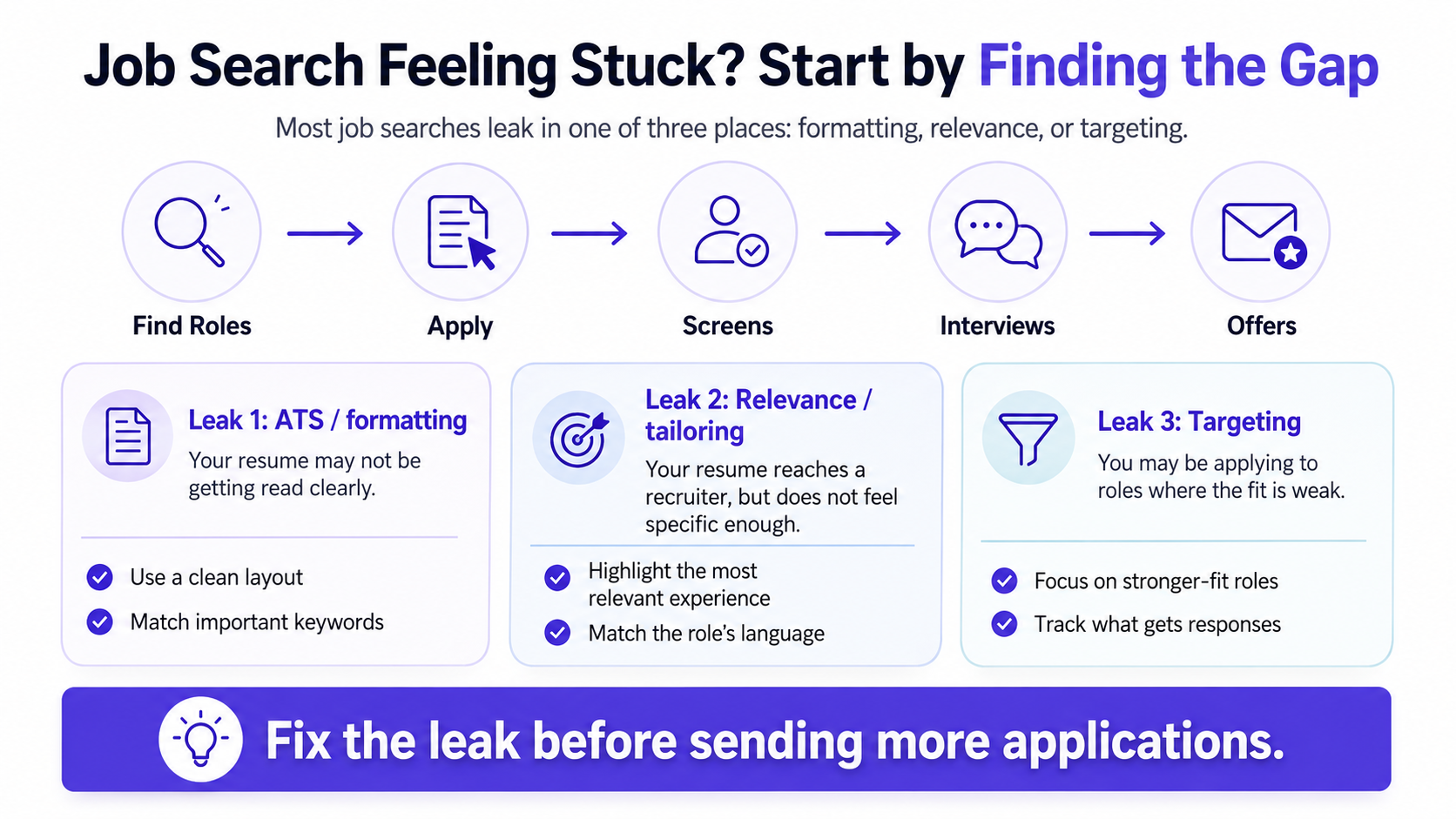
A stuck job search is often a process problem. Somewhere between finding roles, applying, getting screened, interviewing, and receiving offers, something is leaking. The hard part is that nobody gives you analytics for your own job search. You keep putting effort in, but you cannot clearly see where things are breaking.
The fix is not always "apply to more jobs."
The better first step is to find the leak.
Why "I can't find a job" usually comes down to three leaks
A job search works like a funnel:
Roles you find → applications you send → recruiter screens → interviews → offers.
When the search is not moving, one stage of that funnel is usually failing.
Sending more applications into a broken stage only makes you tired faster. A better approach is to understand which part needs fixing.
If silence is the main symptom, our guide to why qualified candidates are not getting interviews breaks the same funnel into nine specific checks.
Leak 1: Your resume never reaches a human
This is one of the most frustrating leaks because it is invisible.
You may have the right experience, but your resume may not be getting read properly. If the format is hard to parse, the layout is too complex, or the most important keywords are missing, your application can get filtered or ignored before a recruiter seriously reviews it.
Common issues include:
- Two-column layouts that do not parse cleanly
- Skills hidden inside icons, graphics, or tables
- Non-standard section headings
- Missing keywords from the job description
- A resume that looks good visually but is not easy for screening systems to read
This does not mean your resume is bad. It may simply need to be cleaner, more readable, and more aligned with the role.
Leak 2: Your resume reaches a recruiter, but does not feel specific
Sometimes the resume gets through, but it still does not create a strong first impression.
A recruiter is usually trying to answer one question quickly:
Does this person make sense for this role?
If your resume reads like it was written for "any job" instead of this job, your fit may not be obvious enough.
The same experience can look much stronger when it is framed around the role.
For example, if the job asks for stakeholder management, campaign reporting, SQL, CRM ownership, or process improvement, those strengths should be visible if they are true for you. If they are buried deep in your resume, the recruiter may miss them.
This is not about pretending to be someone else. It is about making your most relevant experience easier to see.
Leak 3: You are aiming at roles where the fit is weak
Not every rejection is a resume problem.
Sometimes you are applying to roles where you genuinely miss too many must-haves. In that case, even a well-written resume cannot do all the work.
This does not mean you should lower your standards. It means you should aim more carefully.
A better job search is not about applying everywhere. It is about spending more effort on roles where your experience has a real chance of matching what the company needs.
If you are applying to jobs where you match only a small part of the requirement, the issue may not be effort. It may be targeting.
Stop counting applications. Start reading the funnel.
The volume approach feels productive because it gives you a number.
100 applications sounds like progress. 200 applications sounds like even more progress.
But application count is not the metric that matters most.
A better number to watch is your response rate:
recruiter screens ÷ applications sent
If you are sending many applications and getting almost no response, the leak is likely near the top of the funnel. That usually points to resume format, resume relevance, or role targeting.
If you get recruiter screens but things stop after the first call, the leak is probably further downstream.
These are very different problems. You can only see the difference if you track what is happening.
A job tracker helps make this visible. You can move each role across stages like Saved, Applied, Interview, and Offer. You can keep notes on what resume version you used, what came back, and when to follow up.
After a few weeks, you are no longer guessing. You can see patterns.
"Nothing gets a response" is a different problem from "I get calls but not second rounds."
Once you know the real problem, you can fix the right thing.
Fix Leak 1: Make your resume easier to read
Before a recruiter makes a decision, your resume needs to be easy to process.
A clean, ATS-friendly resume helps both screening systems and humans understand your experience faster.
Start with the basics:
- Use a simple structure. Keep your resume clean and easy to scan.
- Use standard headings. "Work Experience," "Education," and "Skills" are clearer than clever alternatives.
- Use real text. Avoid putting key information inside images, graphics, or icons.
- Avoid complex formatting. Tables, text boxes, and heavy design can create parsing issues.
- Match important keywords naturally. If the job says "SQL" and you have SQL experience, use the word "SQL."
DashApply helps turn your existing resume into an ATS-friendly format using clean templates like Classic, Modern, and Compact. You can edit the resume before export, so the final version still feels like yours.
You are not starting over. You are removing the avoidable reasons your resume may not be read properly.
Fix Leak 2: Tailor your resume to the role
Tailoring does not mean rewriting your entire resume for every job.
It means adjusting the version you send so the most relevant parts of your experience show up clearly for that specific role.
Good tailoring usually includes:
- Reordering bullets so the most relevant work appears first
- Using the job description's language where it matches your real experience
- Highlighting the right tools, skills, and outcomes
- Making your summary and skills section more role-specific
- Removing or reducing details that do not help for this role
The goal is simple:
Make the version of you that fits this job easier to see.
DashApply's gap analysis helps you compare your resume against a specific job description. It shows what may be missing, what skills are visible, and where your resume may need stronger alignment.
Some gaps are just wording gaps. You have the experience, but your resume uses different language.
Some gaps are real gaps. You do not have enough of what the role is asking for.
Both are useful to know before you apply.
Fix Leak 3: Choose roles with better fit
A good job search also needs better targeting.
If you are not sure where to aim, look for roles where your experience already overlaps with the job's main requirements.
Ask yourself:
- Do I match most of the must-have skills?
- Have I done similar work before?
- Can I prove the main outcomes this role needs?
- Is this a stretch role, or is it mostly outside my current experience?
- Would my resume make sense to a recruiter in 10 seconds?
Stretch roles are fine. But if every role is a stretch, your response rate will usually suffer.
DashApply's job discovery helps you browse active roles and compare them against your resume, so you can spend more time on jobs where the match is stronger.
Better targeting does not mean playing small. It means giving your effort a better chance.
What a better job search looks like
A better job search is not always bigger.
It may look like this:
- Fewer applications per week
- Better-matched roles
- A clean, ATS-friendly resume
- A tailored version for each important job
- A tracker that shows where each application stands
- Follow-ups that do not get forgotten
- Clear signals on what is working and what is not
This approach may feel slower per application, but it is usually stronger per opportunity.
That does not mean guessing at an arbitrary quota. Use a sustainable range from our guide to how many jobs to apply to per day, then adjust it based on response quality.
Instead of sending the same resume everywhere, you build a system:
Find better-fit roles.
Tailor your resume.
Track the result.
Improve the next application.
That is how you get unstuck.
"I can't find a job" is a real and exhausting feeling. But it is often not the right diagnosis.
You may not have a "you" problem.
You may have a funnel with a leak.
And leaks can be fixed.
Sometimes the leak is the listing itself, not your application. A quick check for ghost-job warning signs can keep stale roles from distorting the funnel.
Ready to try it? Get started with DashApply.
FAQ
Why can't I find a job even though I'm qualified?
Being qualified is important, but it is not always enough. Your resume also needs to be easy to read, relevant to the role, and aimed at jobs where your experience is a strong match. If you are getting very few responses, the issue may be resume formatting, weak tailoring, or role targeting.
How many jobs should I apply to per week?
There is no perfect number. A smaller number of well-matched, tailored applications is usually better than a large number of generic ones. Instead of only counting applications, track your response rate and see whether your current approach is actually working.
How do I know if my resume is getting filtered out by an ATS?
You cannot always know for sure. But if you are applying to many relevant roles and getting almost no response, your resume format or keyword alignment may be part of the problem. Use a clean layout, standard headings, real text, and role-relevant keywords.
What does tailoring a resume to a job actually mean?
Tailoring means adjusting your resume so the most relevant experience for that role is easier to see. It can include reordering bullets, changing your summary, matching important keywords, and highlighting the right proof points. It should not include making up experience.
Should I apply to jobs where I do not meet every requirement?
Yes, sometimes. You do not need to meet every listed requirement. But if you miss most of the must-haves, the role may be a weak fit. A better approach is to focus most of your effort on roles where you already match the core requirements.
How much does DashApply cost?
See pricing for current plans. With DashApply you can upload a resume, tailor it to jobs, check gaps, and track applications.