 The DashApply Team
You've spent hours on your resume, and now it spills onto a second page. The instinct is to shrink the font, tighten the margins, and force everything onto one sheet.
That is usually the wrong move. The right resume length depends on relevant experience, leadership scope, target role, and content density. One page works for many early-career applicants. Two pages often works better for experienced professionals. A CV fits academic, research, and some specialist or international applications.
Table of Contents
- The Honest Answer on Resume Length Right Now
- What the Latest Data Actually Says About Resume Length
- How to Pick the Right Length for Your Situation
- Resume vs CV and When a Two-Page Document Becomes the Wrong Format
- ATS, Recruiter Attention Spans, and Why Length Quietly Matters
- Cutting a Too-Long Resume and Stretching a Too-Short One
- The Myths Worth Forgetting and the Word-Count Detail Most Guides Skip
- A Quick Pre-Submission Length Audit
The Honest Answer on Resume Length Right Now
A two-page resume does not automatically hurt you. The old "one page, always" rule does not fit most professionals. Use one page when your relevant experience and leadership scope are limited. Use two pages when cutting meaningful proof would weaken your application. For students, new graduates, and people with limited relevant experience, one page is still the usual default. Purdue OWL's general guidance, summarized by Indeed's resume-length guide, supports a ceiling of two pages for most applicants.
Still, not every experienced candidate needs two pages. A dense one-page resume beats a padded two-page resume. If page two is filled with repeated duties, generic skills, or unrelated history, cut it. If it adds progression, measurable outcomes, specialized tools, or leadership context, keep it.
Use the document as a sales argument
Your resume is not an autobiography. It is a targeted case for why a hiring team should interview you. Every line should answer at least one of these questions:
- Can you do this work? Show relevant capabilities and tools.
- Have you done similar work? Show roles, projects, and scope.
- Did your work produce results? Show outcomes, improvements, decisions, or influence.
A CV is different. Academic, research, grant-funded, and some international applications may require a full record, not a concise marketing document.
The rest of the decision comes down to evidence. Count the words, inspect the signal on each page, and cut anything that fails the target-role test.
What the Latest Data Actually Says About Resume Length
The market has moved away from treating one page as a universal rule. A 2026 resume report from Enhancv's resume statistics overview found an average resume length of 1.7 pages, with 47% of resumes at two pages, 43% at one page, and 10% at three pages or longer. The same source reports that 68.3% of HR professionals considered two pages ideal, while more than 77% preferred two pages or more.
That does not mean every candidate should add a page. It means two pages is now normal when the content justifies it.
A separate ResumeGo experiment summarized by The Human Capital Hub involved 482 recruiters, hiring managers, HR professionals, and executives. Reviewers preferred two-page resumes about 2.3 times as often as one-page resumes. They also spent an average of 4 minutes 5 seconds reviewing two-page resumes, compared with 2 minutes 24 seconds for one-page resumes. That suggests added length can help when the extra material is useful.
The pattern behind the numbers
The best takeaway is not "two pages always wins." It is that reviewers expect document length to match experience density. An entry-level applicant with limited relevant history usually does not need two pages. A manager, specialist, or executive may.
| Experience level | One-page use | Two-page use | Main test |
|---|---|---|---|
| Student or new graduate | Usually appropriate | Only when substantial relevant work, research, or projects require it | Can the strongest evidence fit clearly? |
| Early professional | Often appropriate | Appropriate when relevant experience has accumulated | Does every added section support the target role? |
| Experienced professional | Possible, but often restrictive | Frequently appropriate | Does page two add progression, scope, or specialization? |
| Senior or executive candidate | Often too compressed | Usually more practical | Does the document explain leadership impact without padding? |
Word count matters too. Resume.io's resume statistics analysis identifies a rough 475 to 600 word sweet spot and reports that 77% of resumes fall outside that range. Page count alone can hide the problem. Two resumes can both run two pages, but one may contain solid evidence while the other relies on loose spacing and vague prose.
The better question is not "Can I force this onto one page?" It is "Does each line strengthen my case for this role?"
How to Pick the Right Length for Your Situation
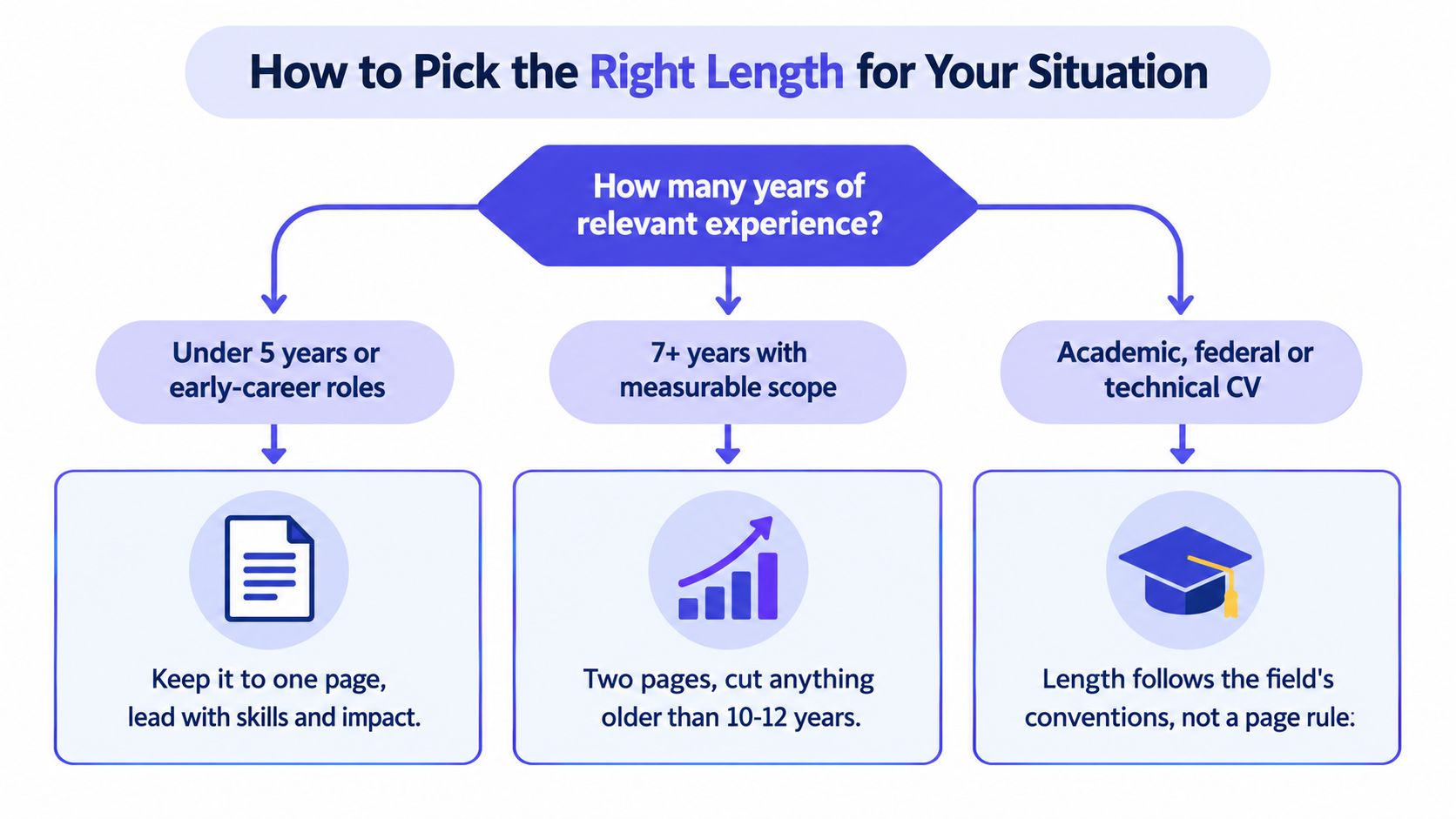
Start with relevant experience, not total years worked. A career changer may have a long work history but little experience that supports the new field. A specialist may have fewer employers but enough depth to justify two pages.
Use this framework:
- Early-career candidate: Use one page when your experience is limited and your strongest proof comes from internships, projects, education, or first roles.
- Experienced professional: Use two pages when you have measurable scope, progressive responsibility, specialized expertise, or several relevant roles that would become vague if compressed.
- Senior leader: Use two pages when leadership achievements, organizational scope, strategic decisions, and business outcomes need context. A third page should be unusual and reserved for highly relevant executive material.
- Academic or research applicant: Use a CV when publications, grants, teaching, peer review, patents, conference presentations, or research appointments are central.
- International applicant: Check local convention before choosing between resume and CV. Terminology and format vary by region.
Let the industry adjust the default
Finance, law, consulting, and technical fields often reward precise documentation because the reader needs evidence of specialization. Creative and startup roles may favor a tighter one-page resume, especially when a portfolio does more of the selling. Federal and academic applications follow their own rules and may require far more detail.
Do not confuse density with cramming. A readable two-page resume with clear hierarchy is better than a one-page document in tiny type. Empty space at the bottom of a page is not a problem by itself. It only means you should decide whether the document needs more relevant evidence or whether one page is already enough.
Run the "so what" test on every bullet. If a line does not show a capability, clarify scope, prove an outcome, or connect to the target role, cut it. If every remaining bullet passes that test, your resume is probably close to the right length.
Resume vs CV and When a Two-Page Document Becomes the Wrong Format
A resume and a CV are not just short and long versions of the same document. They serve different purposes.
A resume is a concise, targeted marketing document. It highlights the experience most relevant to a specific job and usually stays within one or two pages. A CV is a detailed professional record. It can include publications, research, teaching, grants, presentations, professional memberships, licenses, and other accomplishments that would be excessive in a standard resume.
Regional language adds confusion. In the United States and Canada, employers usually distinguish between a resume and a CV. In the United Kingdom, Ireland, and much of Europe, "CV" often means the standard job-application document that Americans call a resume. Always follow the wording used in the vacancy and the employer's location.
| Factor | Resume | CV |
|---|---|---|
| Primary purpose | Targeted case for a specific job | Comprehensive record of professional or academic work |
| Typical content | Relevant employment, achievements, skills, education | Publications, grants, research, teaching, presentations, memberships, and credentials |
| Best fit | Corporate, commercial, startup, and most standard job applications | Academic, research, grant-funded, medical, and specialist applications |
| Editing approach | Remove material that does not support the target role | Preserve relevant professional history and field-specific activity |
| Regional use | Standard term in the United States and Canada | Standard job-application term across much of Europe |
Recognize the CV signals
A CV is usually the right format when the role evaluates your scholarly or professional record, not just recent business impact. Publications, patents, clinical appointments, teaching responsibilities, peer review, conference presentations, and grant activity all point toward a CV.
Medical, legal, and scientific fields may expect CV-style documents even in the United States. Sending a short two-page resume to a research department can make your background look incomplete. Sending a sprawling CV to a standard marketing role can bury the evidence the employer actually needs.
Choose the format first. Then edit the document to fit the job instead of trying to make one file do everything.
ATS, Recruiter Attention Spans, and Why Length Quietly Matters
Applicant tracking systems do not judge page count the way old resume advice suggests. They parse sections, identify text, extract keywords, and pass structured information into the hiring workflow. A standard multi-page document usually is not rejected just because it has a second page.
Formatting still matters. Complicated columns, text boxes, decorative graphics, headers, footers, and unusual symbols can cause an ATS to misread dates, job titles, or contact details. A long resume becomes risky when its layout is hard to parse or when its content buries the language used in the job description.
Recruiters also do not read every document the same way. The first scan is fast, and attention depends on the opening impression. A second page is more likely to get attention when page one establishes a clear match through relevant titles, specific achievements, recognizable tools, and a coherent career story.
Make page one earn page two
Put your strongest evidence near the top. Your headline, summary, skills, and most relevant recent role should quickly tell the reader what you do and why it matters. Page two should deepen the case, not restart it.
A thin one-page resume may leave out important keywords and context. A padded two-page resume may include those terms but bury them in generic statements. The fix is not to repeat keywords mechanically. Use the employer's language naturally in bullets, skills, project descriptions, and role summaries.
For practical formatting guidance, review ATS-friendly resume formatting before exporting the final document. Inside DashApply, you can edit your resume with simple sliders to quickly adjust content density and fit the document cleanly into one or two pages for each target role. Keep headings conventional, place contact details in the main body, and make sure the text remains selectable and readable.
ATS compatibility gets you parsed. Human relevance gets you considered. Your resume has to do both.
Cutting a Too-Long Resume and Stretching a Too-Short One
A resume that runs past two pages usually has an editing problem, not an experience problem. Start with relevance, tighten wording, and only adjust layout after the content is under control.
When the document is too long
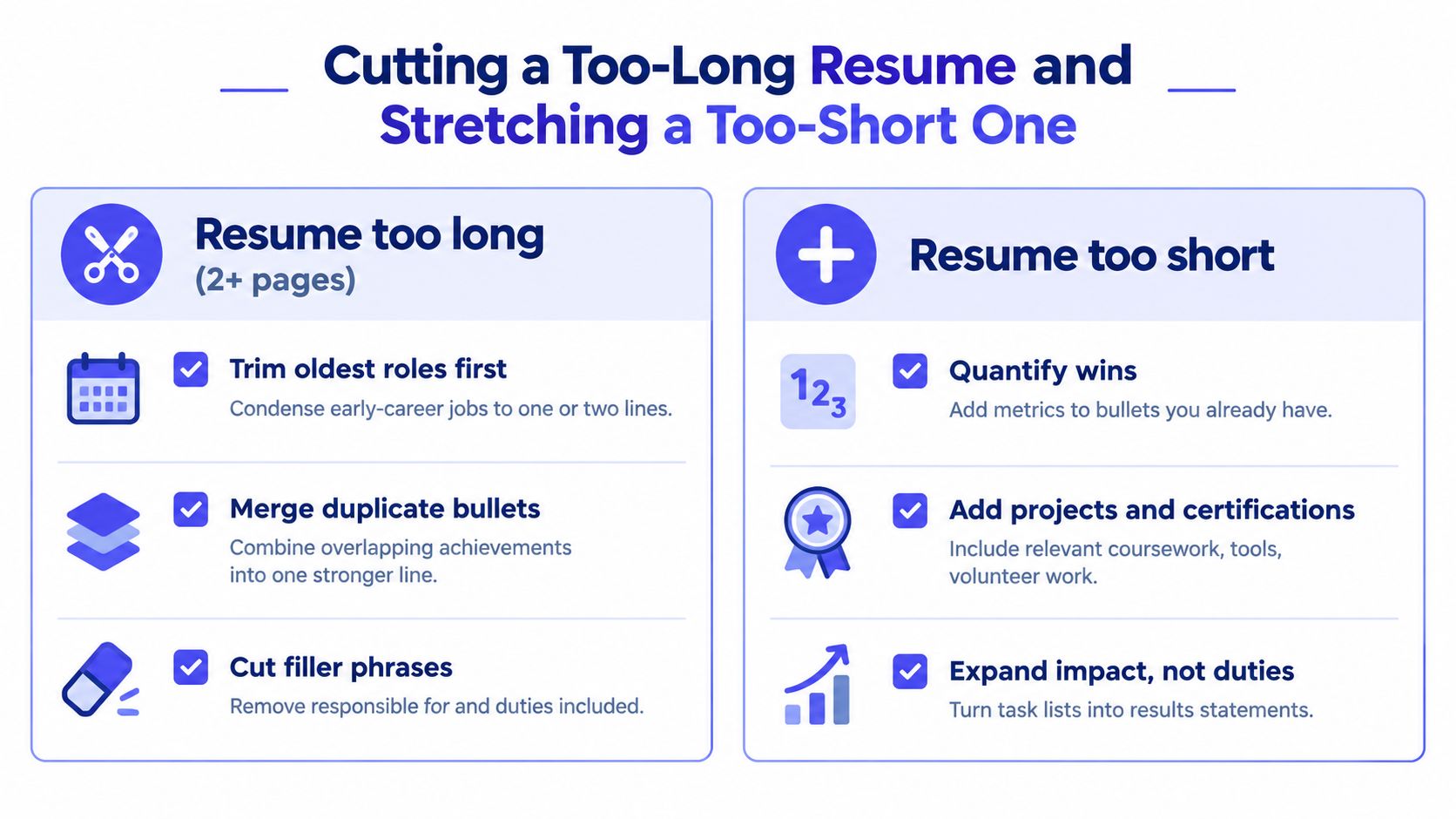
Remove the oldest or least relevant roles first. Keep the title, employer, and dates for early positions if they show progression, but cut their bullets hard. Merge overlapping roles at the same company when the promotion story is clear, and combine duplicate achievements into one stronger statement.
Cut material that rarely helps:
- Objectives: Replace an outdated objective with a focused summary or remove it.
- References: Employers already know they can ask.
- Generic skills: Delete vague claims such as "hard-working" and "team player."
- Filler sections: Remove "Additional Information" content that does not support the role.
- Routine duties: Replace task lists with decisions, improvements, or outcomes.
Then tighten the language. "Responsible for managing campaign reporting" becomes "Built campaign reporting for senior stakeholders," but add an outcome only if you can support it truthfully. Use concrete verbs and remove phrases that take space without adding meaning.
When the document is too short
A sparse page needs substance, not decorative spacing. Expand bullets by adding scope, tools, stakeholders, the problem addressed, and the result achieved. You can also add relevant certifications, projects, volunteer work, professional development, speaking, or technical skills.
Prioritize sections by impact:
- Experience: Give the most space to recent, relevant work.
- Skills and education: Include tools, methods, credentials, and coursework that match the vacancy.
- Supporting evidence: Add projects, volunteer leadership, or professional activity only when it strengthens the application.
If the content is right but the document barely spills onto another page, use readable margins and a professional font rather than extreme compression. Remove visual dividers and excess spacing before sacrificing legibility.
Finish with a density check. Every bullet should contain an action, the work performed, and a result or meaningful contribution. A bullet that only describes a duty should be rewritten or deleted.
The Myths Worth Forgetting and the Word-Count Detail Most Guides Skip
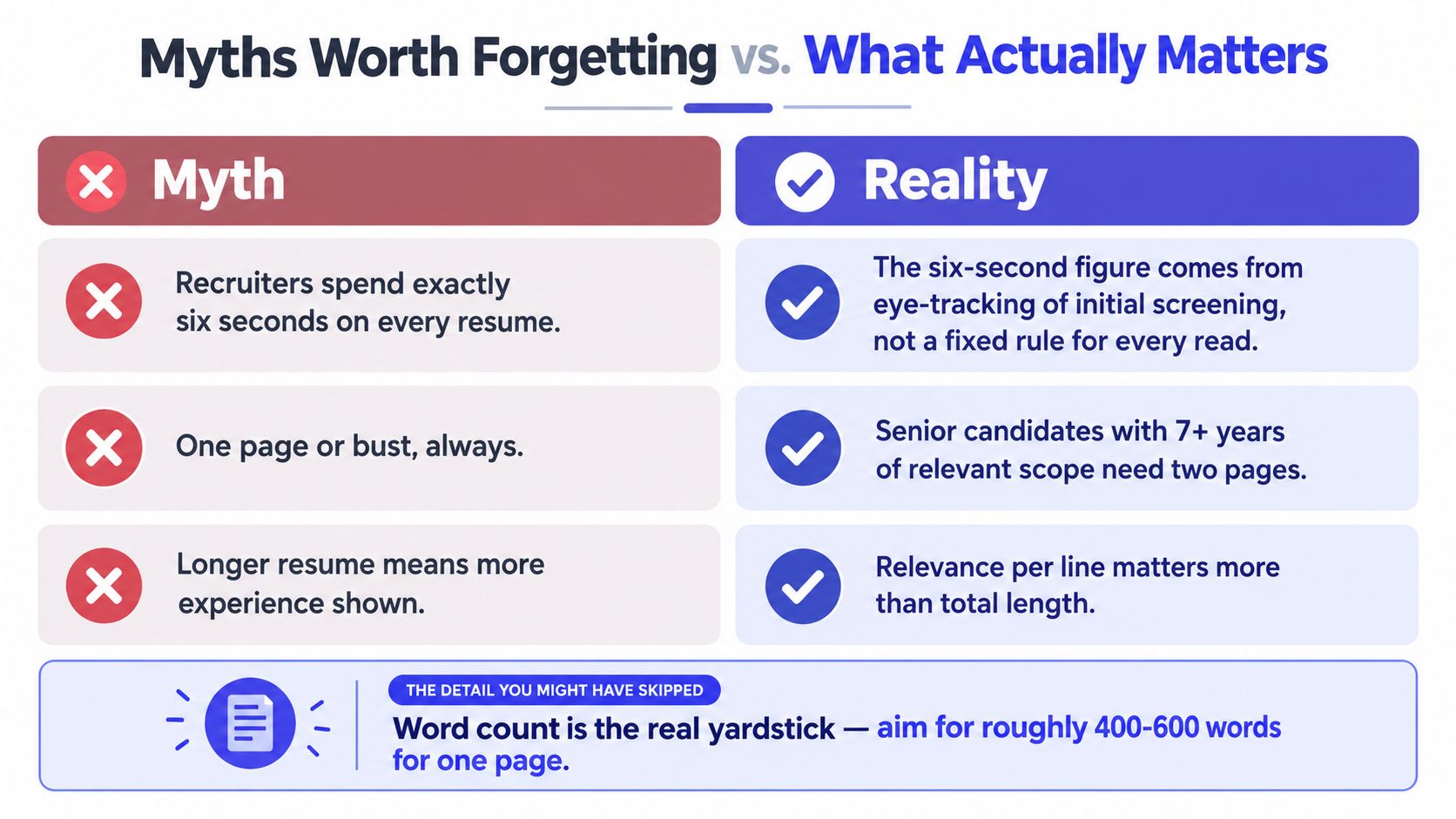
The claim that recruiters spend exactly six seconds on every resume is too rigid to be useful. A fast first scan may happen, but a relevant resume can get deeper attention, while an unclear one may lose the reader immediately. Treat screening time as a reason to strengthen the top third, not as a stopwatch.
The one-page rule also breaks down for senior candidates. Experienced professionals often need room to show progression, specialization, and leadership outcomes. Compressing that record into tiny type does not prove concision. It hurts readability.
ATS penalties for length are another overstatement. Systems can process multiple pages, but they can struggle with cluttered design and weak structure. The main risk is low signal, not page count.
Count words as well as pages
A word-count check exposes padding that page count can hide. Resume.io's analysis points to a rough 475 to 600 word sweet spot and notes that 77% of resumes fall outside it. The range is not a rule, and experienced candidates may need more words to show relevant scope, but it is a useful editing signal for early-career applicants.
Use word count to diagnose the document:
- Too few words: You may be leaving out outcomes, tools, projects, or relevant context.
- A reasonable count on too many pages: Your layout may be inefficient.
- Many words with weak evidence: Delete generic prose and rewrite around results.
- Two focused pages: Keep them if each section supports the target role.
Two tight pages will usually beat three padded pages. The strongest resume delivers the most relevant evidence per line without becoming hard to read.
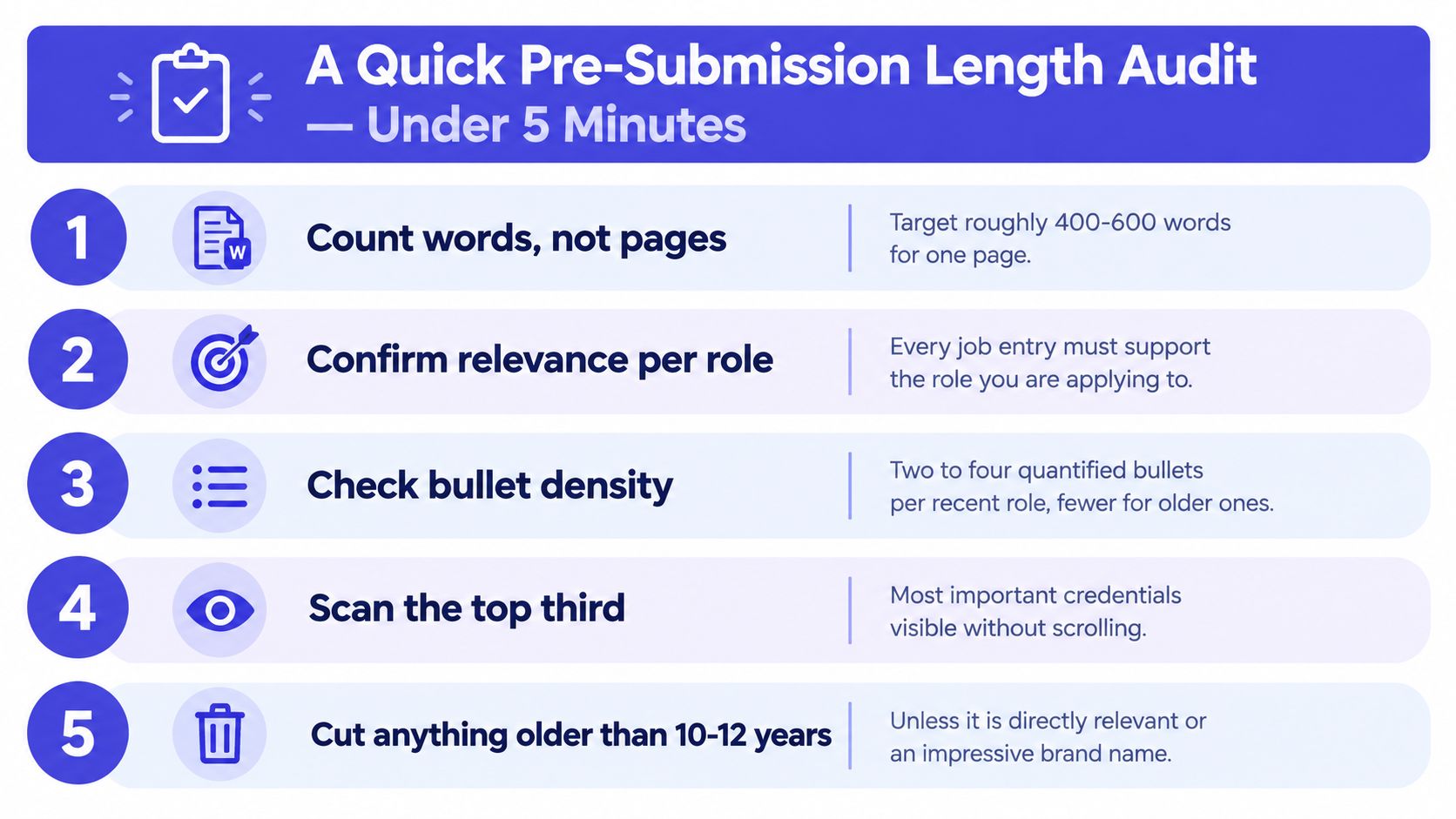
A Quick Pre-Submission Length Audit
Before you apply, review the document like a hiring manager. Do not ask whether it looks short or long. Ask whether the right evidence appears quickly and whether anything takes attention without earning it.
- Count words, not pages. Use word count as a diagnostic. A one-page resume should still show real substance, while an experienced candidate may need more room.
- Confirm relevance per role. Read each job entry against the vacancy. If it does not support your target direction, condense it or remove it.
- Check bullet density. Recent roles deserve the strongest evidence. Older roles should take less space unless they contain directly relevant achievements.
- Scan the top third. Your target title, strongest capabilities, and best recent evidence should be visible immediately.
- Remove stale history. Cut old material unless it supports the role, adds unusual credibility, or explains an important part of your career story.
- Review the contact block. Keep it compact and easy to find. Your name, location, email, phone, and relevant professional profile are enough.
- Inspect every bullet. Delete lines that only list responsibilities. Rewrite the rest with a strong verb, specific work, and a defensible result.
- Read page two alone. If it feels like leftovers, cut it. If it adds useful evidence and flows from page one, keep it.
Use a free ATS resume checker to catch structural or keyword issues, then do the human review yourself. Software can flag missing terms, but it cannot decide whether your strongest achievement belongs at the top of page one.
If you cannot fill a full page with relevant, credible achievements, you do not need a smaller font. You need stronger evidence, sharper positioning, or more experience before applying for that role. If you have enough strong content for two pages, stop apologizing for the second page and edit until every line earns its place.
DashApply analyzes job descriptions, maps them to your strongest experience, and creates tailored resumes and cover letters for specific applications. Inside DashApply, you can edit your resume using simple sliders to quickly adjust content density and fit the document cleanly into one or two pages for each target role, while keeping control over the final draft.