 The DashApply Team
You've read the posting three times. Your resume is open beside it, but you still can't tell whether you qualify. The role asks for forecasting, stakeholder management, and a tool you've barely used. Your experience feels relevant; the wording doesn't quite match.
Translate the work without upgrading it
Choose tools that help you make a decision
Measuring Whether the Work Is Paying Off
Don't let AI write past your evidence
Common Pitfalls and Better Defaults
Check for contradictions and missing details
Reading the Posting for Risk, Not Just Fit
Mapping Keywords to Your Real Experience
Keep a short evidence checklist
A Five-Step Method You Can Repeat Every Time
Think in capabilities, not just duty lists
What Job Description Analysis Really Involves
The Moment You Realize You Might Be the Wrong Reader
Job description analysis clears that up. It helps you identify what matters, connect requirements to evidence you can defend, and decide whether to apply. It won't turn a real gap into a qualification.
Table of Contents
- Why Analyze a Job Description?
- What to Look for in a Posting
- A Five-Step Method
- Match Keywords to Real Experience
- Check the Role for Risks
- Avoid Common Tailoring Mistakes
- Track What Works
Why Analyze a Job Description?
A rejection rarely tells you whether you lacked a qualification or failed to explain one. A posting can make the distinction hard: some lines describe essential work, others name preferred tools, and others are generic filler.
Say you work in sales operations and have built reports, cleaned CRM data, and worked with account executives. A posting asks for “pipeline forecasting required,” “Salesforce preferred,” and “experience with cross-functional teams.” Forecasting may be central to the role. Salesforce may be an advantage rather than a barrier. Cross-functional work may describe something you already do.
Instead of asking whether you match every phrase, ask: What does this employer need done, and what evidence shows I can do it?
Practical rule: A posting tells you what an employer says it wants. It doesn't prove every line carries the same weight.
A useful analysis produces three things: likely selection criteria, evidence from your work, and questions you still need answered. If you can't support an important requirement with a truthful example, mark it as a gap. Don't disguise it with resume wording.
What to Look for in a Posting
A job description is an imperfect account of the role. Read each requirement through three lenses:
- Required or preferred? Treat a stated requirement more seriously than a preference, but check whether the responsibilities support that distinction.
- Capability or tool? “Build a forecast” describes work. “Use Anaplan” names a platform. Experience with another system may show forecasting ability, not Anaplan experience.
- Explicit or implied? “Manage monthly reporting” is clear. “Own the forecast” may also require judgment and communication with leaders.
Recognizable terms help a reader find relevant experience. Specific examples help them assess it. “Stakeholder management” alone says little; coordinating a launch across sales, finance, and operations shows what you did.
The O*NET occupational information framework looks beyond job titles and task lists to skills, knowledge, work activities, and work context. You don't need its taxonomy to analyze a posting. The useful question is what capabilities sit beneath the employer's wording, and whether your experience supports them.
A Five-Step Method
Use the same process for each role, then keep your notes beside your resume while you edit.
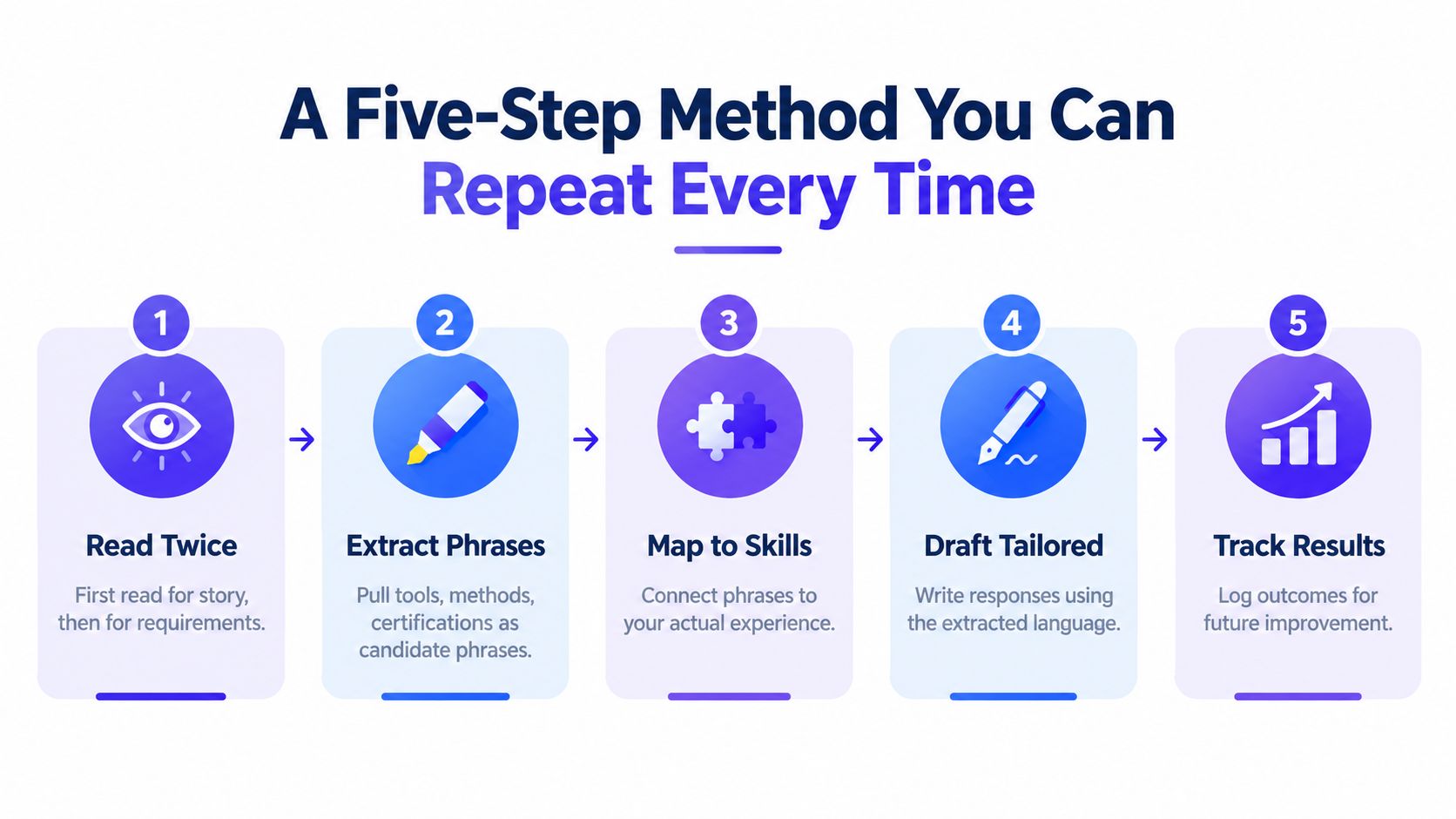
- Read twice. First, identify the role's main purpose. Then mark responsibilities, qualifications, tools, and outcomes.
- Extract key phrases. Pull out certifications, methods, tools, and recurring work. For a finance role, these might include “monthly close,” “variance analysis,” and “partner with department leads.”
- Classify them. Mark each as likely required, preferred, or low-priority, and distinguish capabilities from specific tools.
- Map evidence. For each likely must-have, note a project, responsibility, or result you can explain. If you owned a forecast, record who used it and what you contributed. Add figures only if you can verify them.
- Edit for relevance. Move your strongest examples near the top and use the posting's terminology when it's accurate. “Owned quarterly sales forecasts and reviewed pipeline assumptions with account leaders” says more than “forecasting” in a skills list.
Before submitting, check five things:
- Can you support each likely must-have, or have you marked it as a gap?
- Does the top half of your resume show your strongest match?
- Does your cover letter lead with a relevant example rather than repeat your history?
- Are important terms present only where they accurately describe your work?
- Could you explain every claim in an interview?
Match Keywords to Real Experience
Suppose a marketing operations role asks for HubSpot, SQL familiarity, stakeholder management, and quarterly campaign reporting. You've used Marketo, taken introductory SQL coursework, coordinated agency clients, and produced monthly reports. Map those differences before you edit:
| Posting phrase | Your evidence | Defensible resume language |
|---|---|---|
| HubSpot | Used Marketo | Name Marketo; don't imply HubSpot experience |
| SQL familiarity | Coursework and practice queries | Specify coursework or exercises |
| Stakeholder management | Coordinated agency and client teams | Describe the people, decisions, and deliverables |
| Quarterly campaign reporting | Produced monthly reports | State monthly reporting, not quarterly |
You need both semantic coverage, evidence of the underlying capability, and lexical coverage, accurate terms a reader can recognize. Neither justifies a claim you can't defend. Coordinating clients can support “stakeholder management”; it doesn't automatically make you the owner of executive strategy.
The Bureau of Labor Statistics' occupational-skills framework overview shows how related work can be grouped under shared skill categories. Shared categories can help you translate experience, but they don't erase the difference between coursework and professional use.
Research using O*NET has also described models that compare resume text with occupational skills and tasks. The takeaway for your resume is straightforward: make relevant work easy to recognize without claiming work you haven't done.
For help turning your evidence map into bullets, see this guide to tailoring a resume to a specific job description. Keep a suggested phrase only if you can point to work that supports it.
Check the Role for Risks
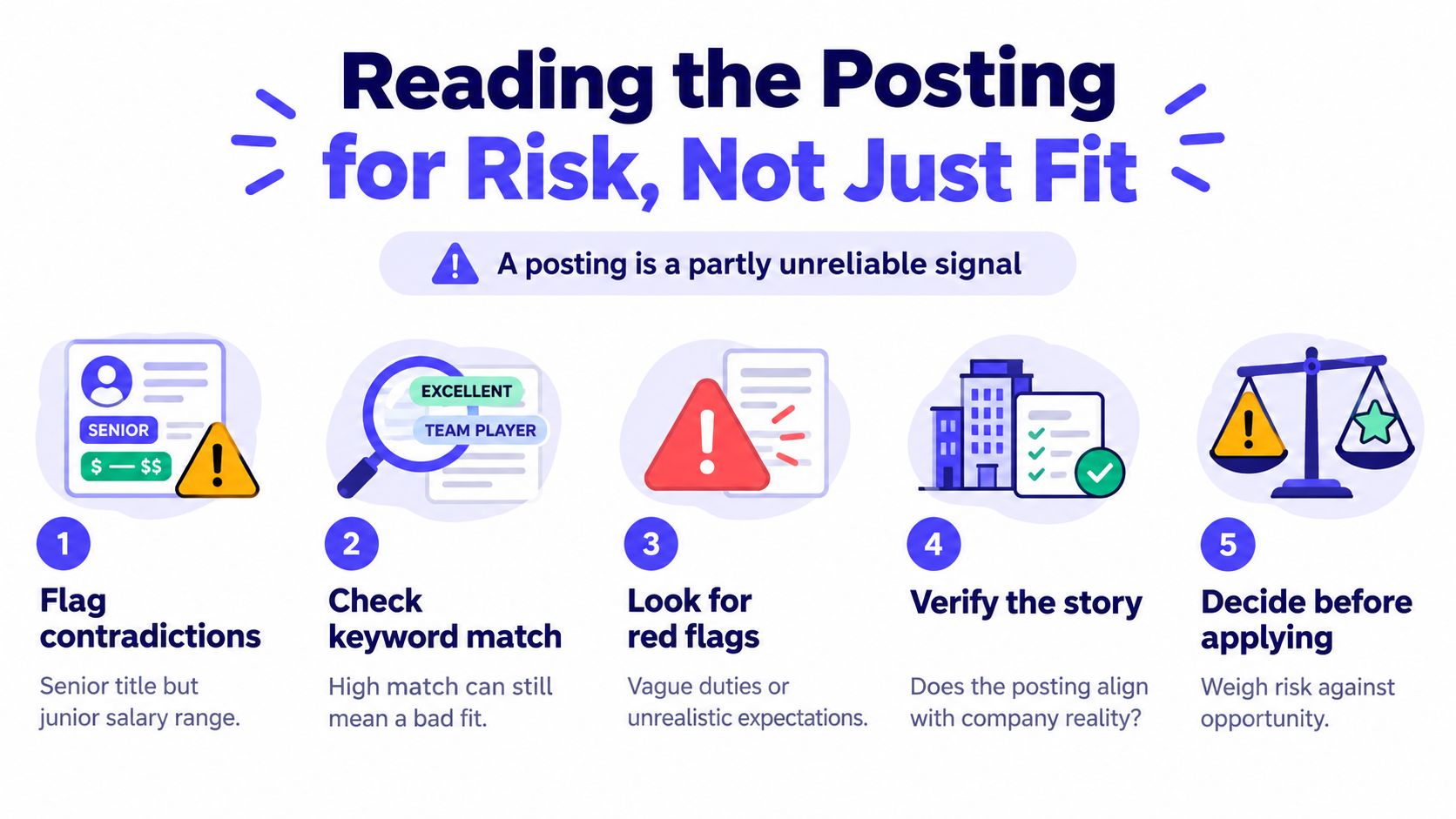
A strong skills match doesn't guarantee a good job. Read for contradictions and missing details before investing time. A senior title with junior duties, an unusually long list of must-haves, or vague ownership expectations may warrant questions.
A resume and hiring statistics report cites a 2025 UK-US study in which 3 in 5 employers reported using AI to write job descriptions. That makes it especially important to assess the actual work, not just how closely your resume mirrors the posting's language.
Check the practical terms too:
- Location: Does “remote” include where you live?
- Employment: Is the role employee or contractor, and can the employer hire in your location?
- Schedule: What time-zone overlap, travel, or hours are expected?
- Authorization: Is work authorization support available if you need it?
- Pay and scope: Does the stated range fit the duties and seniority? Which location and currency does it cover?
A 2025 skills-based hiring report projects wider disclosure of hiring pay ranges by the end of 2026. A projection isn't a range for this role: “competitive compensation” still needs clarification.
If a posting is unusually vague or stays open for a long time, this guide to spot possible ghost jobs offers additional checks. You don't need every answer before applying, but you should know which questions matter to you.
Avoid Common Tailoring Mistakes
- Copying the posting: Use its terms when accurate, then show what you actually did.
- Equating required and preferred: Test your fit against likely must-haves first.
- Inflating tool experience: Name a platform only if you can describe how you used it. Otherwise, state your adjacent experience or training.
- Repeating your resume in a cover letter: Lead with one strong example and its relevance to the role.
- Trusting a match score: Use it to spot missing language, not to predict a hiring decision.
AI can help sort requirements and sharpen wording, but check its drafts for invented tools, upgraded responsibilities, or unsupported results. Coursework isn't production experience; contributing to a project isn't necessarily owning it.
Your resume doesn't need to sound like the posting. It needs to make your relevant experience easy to verify.
Track What Works
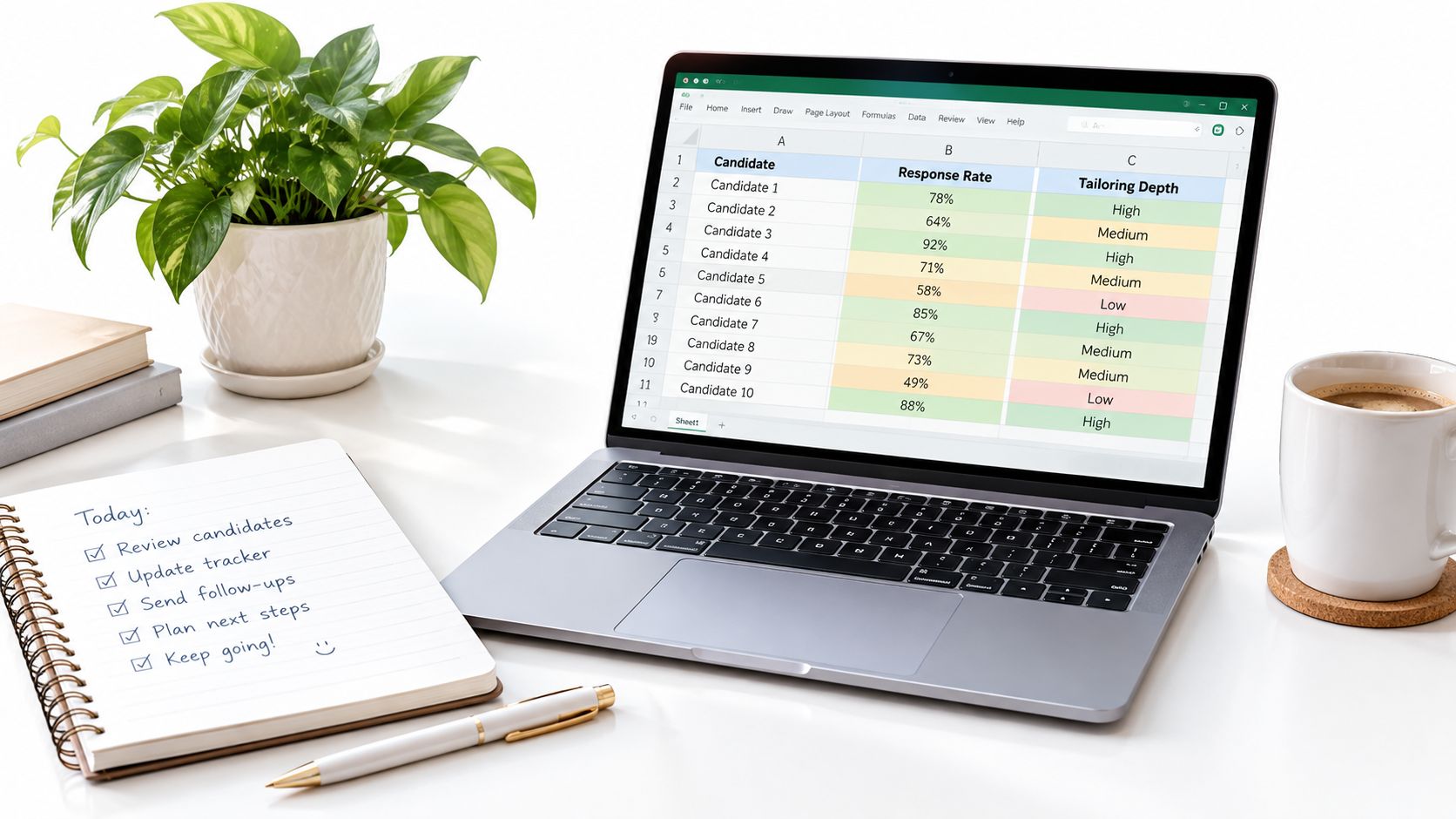
Keep a simple record of each role's type and seniority, how much you tailored, time spent, and whether you got an interview. Compare your own applications over time instead of treating any one outcome as a verdict on your resume.
Even broad labor-market figures change: the Bureau of Labor Statistics' 2025 benchmark revisions revised its January 2025 job-openings estimate downward. Treat match scores with similar caution. They can guide an edit, not forecast a response.
Keyword extractors can surface terms; trackers can organize follow-ups. DashApply compares your experience with a specific job description and shows a live match score before you spend time tailoring. Its gap analysis highlights missing skills and keywords, so you can see where your resume aligns and where it needs attention. Use those gaps to decide what evidence to add, what wording to clarify, and what remains a real qualification gap. The score can guide an edit, but it cannot predict whether you'll get an interview. Review every tailored draft before using it.
Pick one saved posting. Read it twice, classify its requirements, map your evidence, and decide whether to apply, pass, or ask a question. Draft only claims you can defend.
DashApply helps you format ATS-friendly resumes, tailor them to a specific job using your real experience, and track roles and follow-ups, with every draft yours to review and edit. Try it free during early launch, no card required, at DashApply.