 The DashApply Team
You submit an application, close the tab, and promise yourself you will not check your inbox again until tomorrow. Ten minutes later, you are refreshing email, scanning LinkedIn, and wondering whether silence means rejection, delay, or a technical glitch. After enough days like that, the search stops feeling like a path to work and starts feeling like a daily test of your worth.
That reaction is not a character flaw. Job search burnout usually comes from a badly designed process, especially uncontrolled application volume, unclear priorities, and long gaps without feedback. The way out is not to push harder. It is to redesign the search so each action has a purpose, each pause is intentional, and silence does not run your day.
A better process also needs a better workspace. When your search is spread across tabs, documents, reminders, drafts, and portals, the admin work becomes its own source of stress. A system like DashApply helps reduce that load by keeping your applications, tailored materials, and follow-ups in one place, so you spend less energy managing the search and more energy making good decisions.
Table of Contents
- Recognizing the Burnout Trap
- The Hidden Cost of Silence and Ghosting
- Your Step-by-Step Recovery Roadmap
- Scaling Applications Without the Burnout
- Building a Sustainable Job Search Routine
Recognizing the Burnout Trap
A candidate I coached once opened her application tracker and stared at a dashboard that looked painfully familiar: rows of company names, dates, role titles, and status labels that had not changed in weeks. She had done what people told her to do. She customised resumes, searched daily, followed up, and kept applying after each rejection. Yet the tracker showed no sign that the effort was working.
Burnout rarely arrives as one dramatic collapse. It builds through small shifts in behavior. You postpone applications because another form makes you tense. You read job descriptions without absorbing them. You check messages compulsively, then avoid your inbox because you expect bad news. Eventually, even promising roles feel threatening instead of motivating.

Frustration or exhaustion
Normal frustration usually leaves room for recovery. You may dislike rejection, but you can step away, enjoy an evening, and return with a clearer head. Burnout is different. The search follows you into sleep, conversations, weekends, and unrelated tasks. You stop separating an employer's decision from your identity.
Watch for these signals:
- Compulsive checking: You refresh email or portals because uncertainty feels impossible to tolerate.
- Avoidance: You stop opening platforms, ignore useful contacts, or leave strong applications unfinished.
- Volume without judgment: You apply to poor-fit roles just to feel productive.
- Emotional flattening: Rejections no longer surprise you, but nothing excites you either.
- Self-criticism: You treat silence as proof that your skills, age, experience, or direction is the problem.
- Physical disruption: Sleep, appetite, concentration, or routines start to slip.
Practical rule: If the search is consuming your ability to search well, more applications will make it worse.
The numbers show this is not vague frustration. In a 2024 survey of 2,129 U.S. job candidates, 46.8% said searching for work hurt their mental health, and 55.3% said waiting after applying or interviewing was their biggest source of stress, according to iHire's survey findings on job-search wellbeing. Waiting, not just applying, is where many candidates lose their footing.
Find the loop, not a personal defect
Burnout follows a predictable loop: uncertainty creates anxiety, anxiety drives more checking or more applications, extra effort produces little feedback, and the lack of feedback raises anxiety again. You may respond by lowering your standards, widening your search without a strategy, or working longer hours. That creates more fatigue without doing much to improve your odds.
Before changing your resume, ask a simpler question: what part of the system is draining me most? Is it searching, tailoring, submitting, waiting, interviewing, or interpreting every outcome? The answer points to the fix. A candidate overwhelmed by forms needs workflow support. Someone trapped in inbox checking needs communication boundaries. Someone applying everywhere may need a narrower target, not more motivation.
For many candidates, the draining part is fragmentation. The search lives in too many places, which means every next step takes more effort than it should. Keeping roles, documents, follow-ups, and status updates in one workspace reduces that friction. That is where a tool like DashApply fits best, not as a shortcut for thought, but as the system that helps you think clearly and act consistently.
The Hidden Cost of Silence and Ghosting
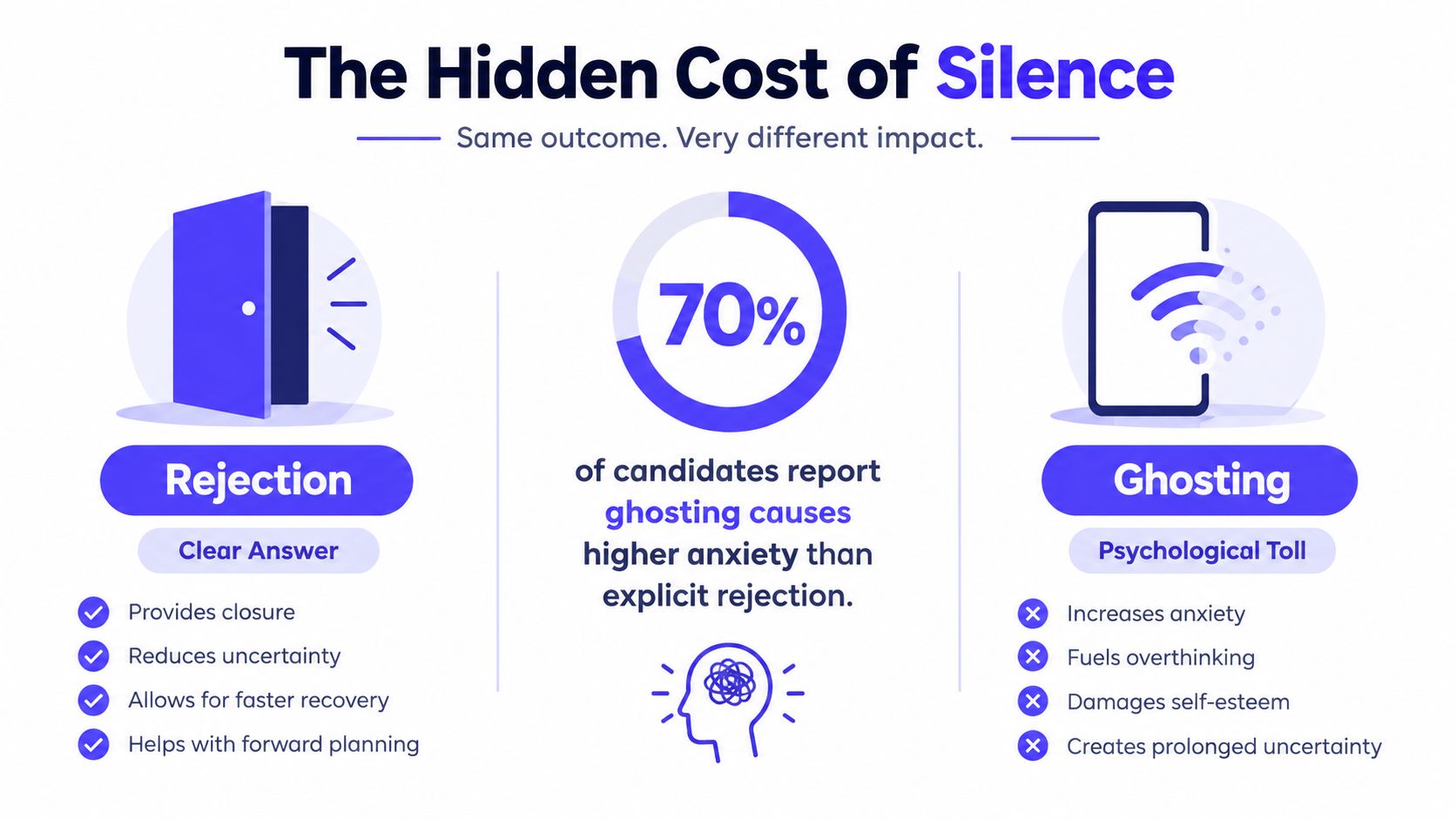
Rejection hurts, but it closes a loop. Silence keeps the loop open. You do not know whether the recruiter missed your application, the role was put on hold, another candidate is in final interviews, or the company was never hiring urgently. Your mind keeps generating explanations because it has no clear event to process.
That is why ghosting is often more corrosive than a direct no. You cannot confidently redirect your energy, so every quiet application stays psychologically active. You keep checking the portal, drafting follow-ups, and wondering whether one more tweak could revive the opportunity.
What the feedback gap does
The data points to a hiring-process problem, not a resilience problem. A Checkr report on the hiring disconnect found that 59% of job seekers identified ghosting as their biggest challenge, while 62% said a lack of feedback harmed their confidence and mental health.
Those numbers explain why high application volume can become emotionally risky. Each application asks you to research a company, present your experience, imagine a future there, and tolerate evaluation. If the employer never responds, you get neither useful feedback nor closure. You get another unresolved case.
Low response rates make it worse. An Insight Global survey reported that job seekers applied to around 30 jobs on average but received only four callbacks or responses, a roughly 13% response rate, as described in the survey's job-hunt burnout report. The exact number is not a verdict on your employability. It shows how much effort candidates may spend for very little feedback.
A cleaner process helps here too. When every application is tracked in one place, with a clear next action and follow-up date, silence feels less chaotic. You may not control the employer's response, but you can stop each unresolved application from taking up constant mental space.
Stop treating silence as a verdict
Hiring teams can lose approval, cancel a requisition, change the role, prioritize an internal candidate, or simply manage communication poorly. Those explanations do not make ghosting acceptable, but they matter when you interpret the outcome. A company's silence is evidence about its process, not reliable evidence about your value.
That should change your operating rules. Set a follow-up point before you submit. After that point, move the application to a waiting category and stop giving it daily attention. If a role has unclear ownership, vague requirements, or signs of being inactive, protect your energy by investigating before tailoring. A useful companion is this guide on how to spot ghost jobs, because better filtering reduces the number of uncertain applications you carry.
You cannot force every employer to communicate. You can stop letting every employer's communication failure occupy your mind.
Your Step-by-Step Recovery Roadmap
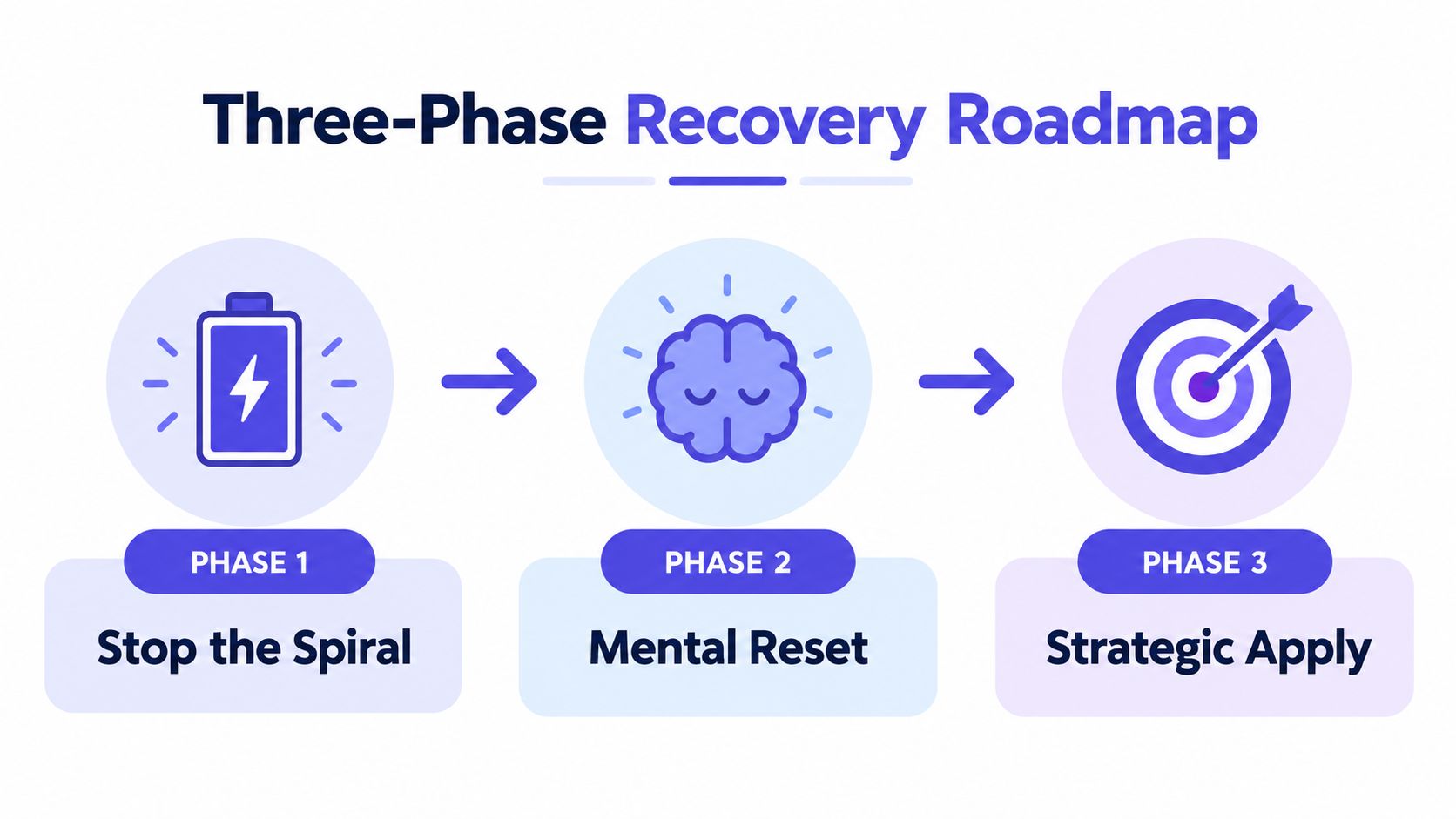
Recovery requires an operational change, not a motivational speech. When candidates are exhausted, I use a three-phase process: stop the spiral, restore decision quality, then apply strategically. Skip the first phase and you often get a brief burst of effort followed by another crash.
Phase one, stop the spiral
Pause active applications long enough to regain control. This does not have to become an indefinite withdrawal. Define what is temporarily off-limits, such as new applications, job-board scrolling, or portal checking, while still handling scheduled interviews and time-sensitive tasks.
Use the pause to close open loops:
- Label every existing application. Separate active interviews, applications awaiting a response, roles you no longer want, and roles that need one last follow-up.
- Schedule communication. Choose a specific time to send follow-ups, then archive or mute the thread.
- Remove application triggers. Sign out of job boards, disable unnecessary alerts, and keep employment platforms out of your bedroom or evening routine.
- Tell one trusted person. Explain that you are not abandoning your career. You are reducing a process that has become harmful.
A pause can feel irresponsible because many job seekers fear any break means falling behind. Recent reporting found that 53% of U.S. workers had paused their job search to protect their mental health, according to Fortune's coverage of the Glassdoor poll. A deliberate pause is not giving up. It creates room to make decisions from evidence instead of panic.
Phase two, restore decision quality
Your next task is not to find more jobs. It is to rebuild the conditions that let you judge jobs clearly. Restore daily structure with activities that produce visible progress: exercise, cooking, volunteering, learning, household tasks, or conversations with people outside the search.
Then audit your target. Write down the role families, industries, work arrangements, locations, compensation requirements, and deal-breakers that matter. Separate requirements from preferences. A wide search can look flexible, but it often forces you to rewrite your story for roles you would not accept.
Use a simple decision test for each opportunity:
| Question | What a strong answer looks like |
|---|---|
| Does the role use my strongest evidence? | I can name relevant projects or outcomes without stretching. |
| Do I understand the hiring need? | The responsibilities and success criteria are reasonably clear. |
| Is the process worth the effort? | The company provides enough information to justify tailoring. |
| Would I accept the role? | The role meets my non-negotiable conditions. |
If several answers are weak, do not compensate by writing a longer cover letter. Remove the role from your priority list.
Phase three, apply strategically
Reintroduce applications in controlled blocks. Start with roles that meet your criteria and let you show a clear match. For each one, identify the employer's likely problem, choose the strongest evidence from your background, and adapt your resume around that evidence.
This is where the right workspace can ease the load. DashApply helps you tailor your resume for each role in about a minute, generate a relevant draft from the job description, and keep the version tied to that application. Instead of juggling duplicate files and half-finished edits, you keep your materials connected to the role they were built for.
Keep a decision log, not a shame log. Record the role, your match rationale, the version of your materials, the follow-up date, and what you learned. This gives you controllable feedback even when the employer stays silent.
A sustainable search measures completed decisions and useful learning, not just submissions.
Review the process periodically. If applications produce no conversations, inspect positioning, role fit, resume clarity, and sourcing channels one at a time. Do not change everything after every rejection. A calm search makes smaller, more useful adjustments.
Scaling Applications Without the Burnout
The spray-and-pray model confuses activity with progress. Sending many generic applications can make a hard search feel measurable, but it also creates repetitive work, weakens personalization, and fills your tracker with opportunities you never really wanted.
The alternative is a pipeline with three stages: discover, adapt, and submit. Each stage needs a stopping rule. Without one, job boards expand forever and application tasks take over your day.
Compare the two workflows
| Spray and pray | Targeted workflow |
|---|---|
| Apply whenever a title looks vaguely familiar | Screen roles against defined requirements |
| Reuse one resume without checking alignment | Adapt evidence to the employer's stated needs |
| Track submissions as the main success metric | Track fit, follow-ups, responses, and lessons |
| Work whenever anxiety appears | Use scheduled blocks with a clear stopping point |
| Treat every application as equally important | Reserve energy for roles with credible potential |
The targeted method takes more judgment upfront, but it cuts wasted effort later. Start by extracting the role's core requirements and separating true essentials from inflated wish lists. Then map each important requirement to a specific project, responsibility, result, or capability in your background. If you cannot find credible evidence, decide whether the gap is acceptable before spending time on the application.
Automation can help with repetitive work, but it should not replace your review. Tools such as resume analyzers can flag missing terms and suggest edits. A platform such as DashApply can analyze job descriptions, tailor your resume for every role in about a minute, generate resume and cover letter drafts, autofill repetitive fields, and track every application in one workspace. The value is not just speed. It is having one place to manage the search, reduce tab overload, and stay on top of what needs attention next. You still need to verify accuracy, tone, claims, and answers before submission.
Batch the work
Separate tasks by cognitive demand. Searching for roles requires different attention from writing evidence or completing forms. Mixing all of them into one long session creates decision fatigue.
A practical batch might look like this:
- Discovery block: Save only roles that meet your target criteria.
- Qualification block: Remove unclear, unsuitable, or low-priority listings.
- Tailoring block: Adapt materials for the strongest opportunities.
- Submission block: Review every field and submit deliberately.
- Review block: Update statuses and record the next action.
Do not let automation become another source of pressure. If a tool makes it easier to submit more applications, that does not mean you should. The point is to reduce manual friction while preserving judgment and recovery time.
The underlying response environment can be discouraging. Insight Global's survey found that applicants sent around 30 applications on average and received four callbacks or responses, producing a roughly 13% response rate. The lesson is not to chase a higher number. It is to make each submission informative enough that you can tell the difference between a targeting problem and normal hiring silence.
For a more deliberate workload, use this guide to deciding how many jobs to apply to per day and adjust the pace when application quality or your wellbeing declines.
Keep the dashboard useful
A tracker should answer practical questions quickly. Which applications need action? Which resume version led to a conversation? Which role type repeatedly fails the fit test? If your dashboard only counts submissions, it encourages volume and hides quality.
Use clear statuses such as saved, qualified, tailoring, submitted, follow-up due, interview, closed, and withdrawn. Review it during a scheduled block, not whenever anxiety rises. A visible next action turns open-ended worry into a contained task.
This is where an all-in-one workspace matters. When your tracker, tailored resumes, drafts, and application statuses live together, you spend less time reconstructing what is going on. DashApply is useful here because it is not just another job tool to check. It can become the main workspace that declutters your search and helps you stay organized without scattering your attention.
Building a Sustainable Job Search Routine
A sustainable routine protects three resources: attention, confidence, and recovery time. Treat the search as one part of your day, not the environment your whole day happens inside.
Set a start and stop time. Keep job boards, email, and professional networks outside those boundaries unless an interview or employer request needs immediate action. Turn off nonessential notifications and decide when you will check for responses. Silence is still unpleasant, but scheduled checking stops it from interrupting everything else.
Your routine should include more than applications. Make room for movement, social contact, practical work, learning, and activities that remind you of competence outside employment. Passive scrolling can look like rest while keeping you emotionally tied to the search. Choose recovery that shifts your attention instead of repeatedly exposing you to other people's announcements and advice.
Use a weekly review to make strategic adjustments:
- Fit: Are the roles aligned with your actual target?
- Evidence: Do your materials show relevant accomplishments clearly?
- Friction: Which steps consume energy without improving the application?
- Feedback: What can you learn from conversations, referrals, or responses?
- Health: Is the current pace sustainable next week?
When the search disrupts sleep, relationships, concentration, or basic functioning, involve a qualified mental health professional or other appropriate support service. Career strategy helps with process design, but it is not a substitute for care when distress becomes persistent or severe.
The strongest routine does not make you endlessly resilient to a broken process. It limits your exposure to that process, improves the decisions you can control, and keeps your identity larger than your application tracker. You do not need to earn rest by receiving an offer. Rest is part of the system that lets you search well.
DashApply supports that kind of routine by making the search easier to hold in your head. When you can tailor a resume quickly, track every role in one place, and see what needs action next, the process feels less scattered and less heavy.
DashApply helps reduce repetitive application work by tailoring resumes and cover letters to job descriptions, autofilling application fields, and tracking statuses in one dashboard while keeping you in control of final submissions. If job search burnout is making every application feel heavier than it should, visit DashApply to build a more focused, lower-friction workflow.