 The DashApply Team
You've found a promising role. Then you compare the posting with your resume, and the work you know how to do looks nothing like the work they're asking for.
Start with your most promising saved role
Run this checklist before you send
A simple workflow for your next application
Leave room for a credible stretch
Use a stop rule instead of chasing a score
When mapping should tell you to walk away
Show behavior rather than a flattering adjective
Transferable doesn't mean interchangeable
Why mapping matters more in a skills-based hiring market
Add strength, recency, and proficiency
Build the map before polishing the bullets
A worked example for a marketing or sales role
Evidence makes the connection credible
Capabilities explain how someone does it
Tasks describe what needs doing
The three layers of a strong job map
Standardize the language, preserve the differences
What job mapping actually means
The moment every job searcher has had
Job mapping helps you find the real overlap, identify the gaps, and decide what to put in your application.
Table of Contents
- The gap isn't always a skills gap
- What job mapping means
- The three layers of a job map
- A worked example
- Why evidence matters in skills-based hiring
- When to skip the role
- A workflow for your next application
The gap isn't always a skills gap
A posting asks for stakeholder management, customer retention, and performance analysis. Your resume says you supported account reviews, prepared reports, and coordinated with colleagues.
You may have relevant experience, but the connection isn't clear. Consider an operations coordinator moving into customer success. They resolved delivery issues, updated clients, and brought internal teams together. Their resume emphasizes administration; the vacancy emphasizes relationships and problem-solving.
Before rewriting, sort each requirement into one of three possibilities:
- Similar work, different wording: You did the underlying task under another name.
- Related work, different responsibility: You supported the task but didn't own the outcome.
- A real gap: You can't yet demonstrate the requirement.
The response might be a clearer resume bullet, an explanation of transferable experience, or a decision to pursue a different role. It shouldn't be a synonym swap that inflates what you did.
What job mapping means
Job mapping connects a job's requirements to specific evidence from your experience. First, translate the posting into tasks and capabilities. Then identify what you've done, where you did it, and how closely it matches.
Occupational frameworks can help you interpret unfamiliar titles. The U.S. Department of Labor's O*NET occupational information system describes occupations through tasks, skills, knowledge, abilities, and other requirements. Its Code Connector links job titles to broader occupations. The European Commission's ESCO framework also connects occupations and skills. It covers 3,039 occupations and 13,939 skills in 28 languages.
You don't need to consult a database for every application. The lesson is to compare the work, not just the titles. Coordinating a campaign and owning campaign strategy are related, but they aren't equivalent.
| Keyword matching asks | Job mapping asks |
|---|---|
| Does the term appear? | What work does the requirement describe? |
| Does my resume use similar wording? | What evidence shows I can do that work? |
| Which phrases should I add? | What can I claim accurately, and where are the gaps? |
Use the employer's terms when they accurately describe your work. A keyword is a useful label, not proof.
The three layers of a job map
O*NET's occupational database model separates tasks, knowledge, skills, abilities, and other descriptors. For an application, a simpler map has three layers: tasks, capabilities, and evidence.
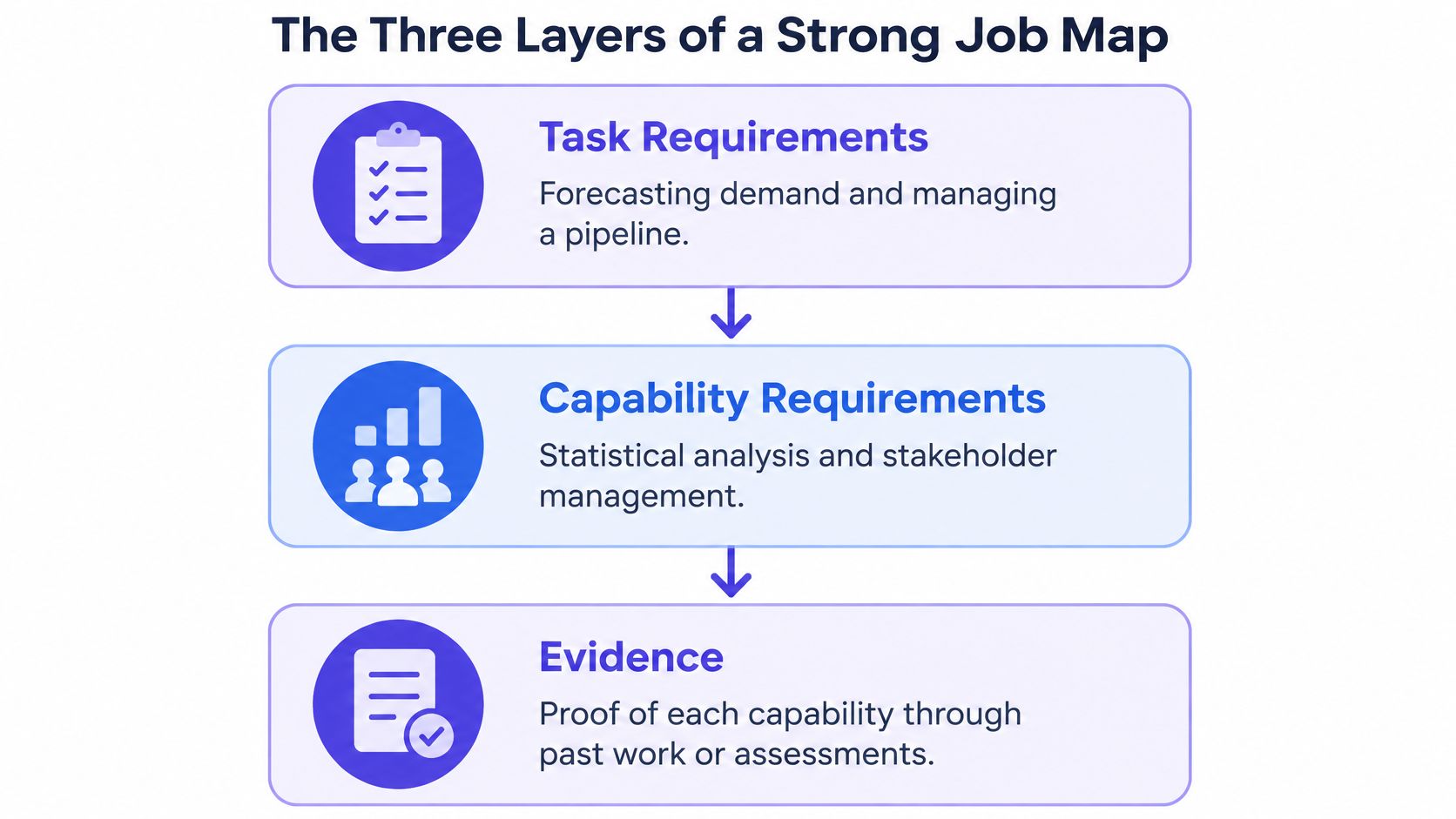
Tasks
Tasks are concrete activities, such as forecasting demand, preparing a budget, or coordinating a launch. Look for verbs and their objects. "Review campaign performance and recommend budget changes" is easier to assess than "analytical self-starter."
Capabilities
Capabilities are what the task draws on: analysis, communication, prioritization, or commercial judgment. Don't turn an implied skill into a required qualification. Coordinating a launch may require prioritization; it doesn't necessarily mean managing staff.
Evidence
Evidence shows what you personally did. Include the method, tool, scope, deliverable, or result where useful. "Python" is a label; "used Python to automate a reporting process" shows application. Add a result only if you can verify it.
Rule: Don't make a resume claim stronger than the evidence you can explain in an interview.
Record each requirement beside your evidence, ownership, recency, and any uncertainty. If you're unsure what to extract, start with this guide to reading a job description for keywords.
A worked example
Suppose a demand-generation posting asks for email campaigns, funnel analysis, sales coordination, and paid acquisition. The candidate has marketing coordination and customer-facing operations experience. This example is hypothetical.
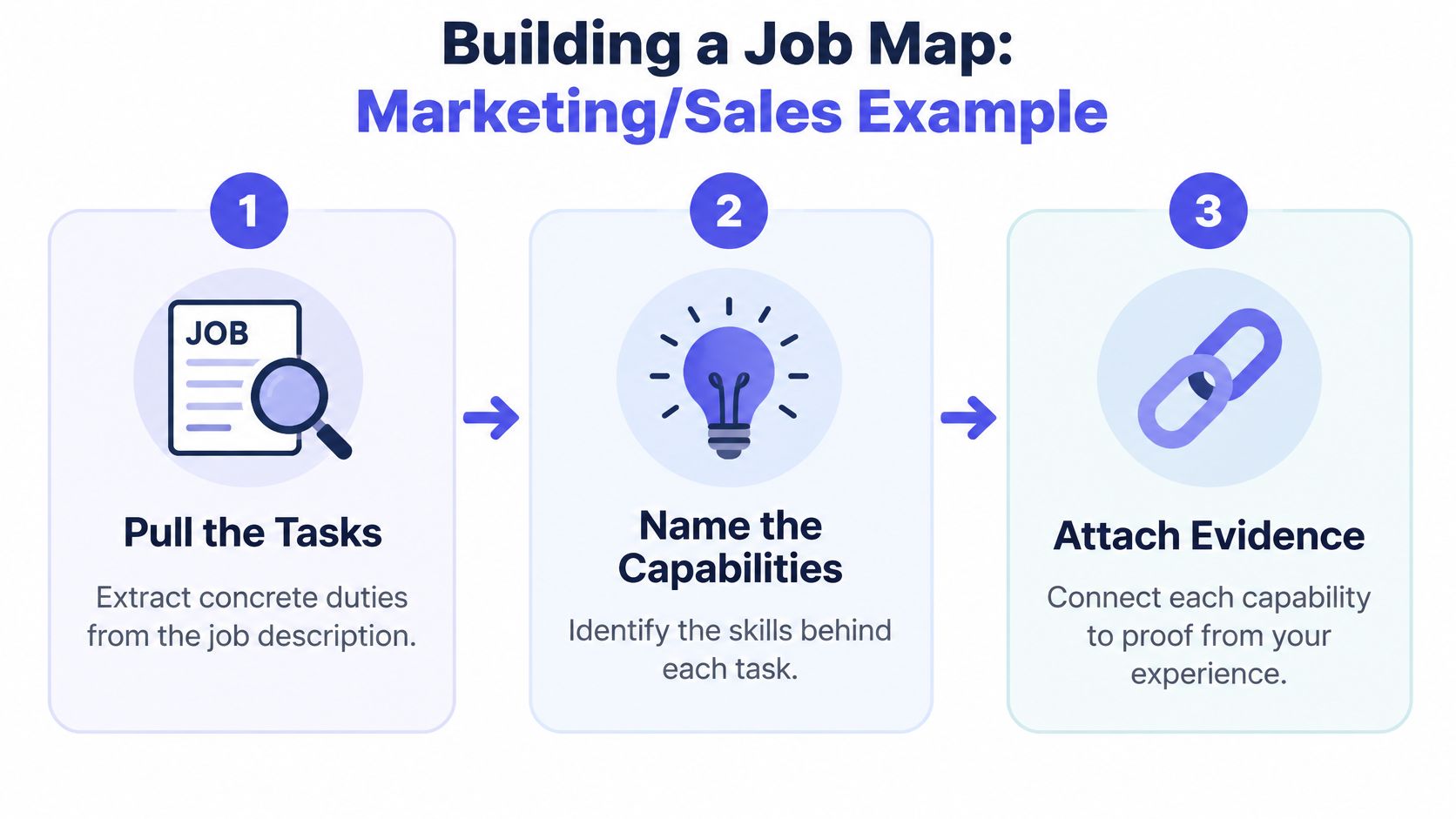
Build the map
| Requirement | Hypothetical evidence | Match |
|---|---|---|
| Run email campaigns | Built segmented emails and coordinated approvals | Direct: Similar work |
| Coordinate with sales | Managed client handoffs between service and account teams | Transferable: Relevant capability, different setting |
| Review funnel performance | Prepared engagement reports but didn't analyze pipeline conversion | Adjacent: Partial overlap |
| Manage paid acquisition | No hands-on campaign or budget experience | Missing: No credible evidence yet |
These categories guide what you say. Describe direct work clearly. Explain the context of transferable work. Keep adjacent claims narrow. Don't disguise missing experience.
Check strength, recency, and ownership
For the email requirement, the candidate's entry might be:
Evidence: Built audience segments, configured sends, checked links, and coordinated approvals in the current role.
Ownership: Executed campaigns independently; a manager approved strategy.
Boundary: Did not own the acquisition budget.
A defensible resume bullet could be: "Built segmented email campaigns and coordinated approvals, send setup, and post-send reporting." Use it only if every activity is accurate.
The handoff experience needs a sentence explaining its connection to sales coordination. Funnel analysis needs a narrower claim or a clearly labeled learning project. If paid acquisition is the role's central duty, the gap may be a reason to skip it.
Why evidence matters in skills-based hiring
A skills list says what you know; evidence shows how you've applied it. In NACE's 2025 Job Outlook Spring Update, almost two-thirds of surveyed employers reported using skills-based hiring, while fewer than 40% screened by GPA for the third consecutive year, according to this University of Wyoming career-services summary. Those results describe surveyed employers, not every hiring process.

Transferable isn't interchangeable
O*NET distinguishes occupation-specific tasks from transferable skills. A finance professional who investigated discrepancies may have relevant root-cause analysis experience for an operations role. That alone doesn't establish warehouse-management experience.
Name the transferable capability, show where you used it, and acknowledge any specialized work you haven't done.
Show behavior, not adjectives
The EEOC's guidance on employment-selection procedures emphasizes the relationship between selection methods and job behaviors or work products. For your application, observable work is more informative than a flattering adjective. Explain how you reconciled conflicting inputs rather than calling yourself detail-oriented.
When to skip the role
Mapping should help you decide whether to apply, not just improve your wording. Application volume makes that decision worth your time: a Clutch report on AI in hiring describes Workday-related data showing a median 69 applicants for filled roles in July 2026, up from 58 a year earlier. It's a dated snapshot, not a prediction of your chances.
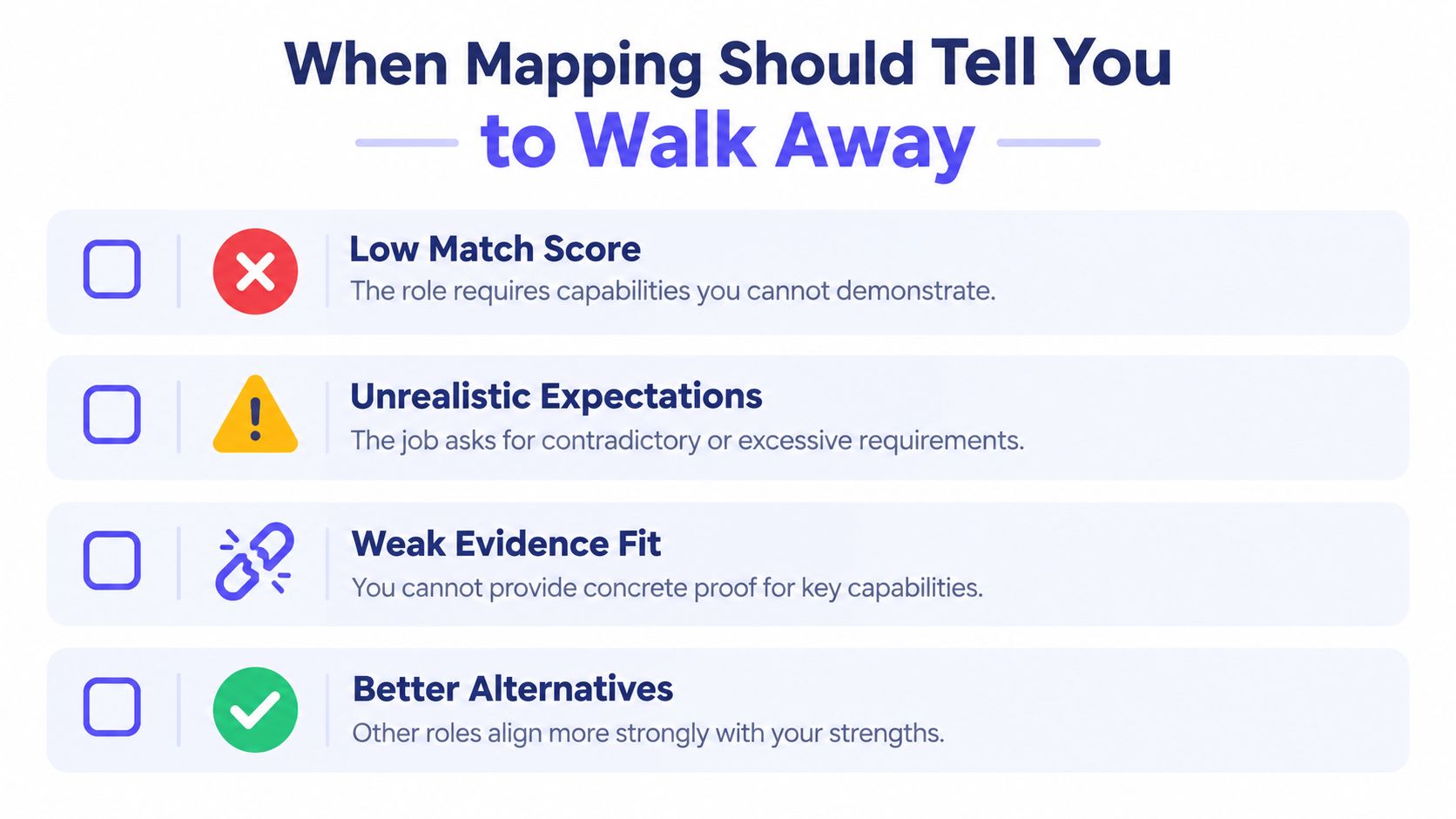
Before tailoring, check what wording can't fix:
- Core work: Can you demonstrate the capabilities central to the role?
- Ownership: Have you held the level of responsibility it requires?
- Eligibility: Do location, authorization, or other stated requirements rule you out?
- Alternatives: Is another available role a clearer fit?
A missing preferred tool may be a reasonable stretch. A missing essential qualification is different. Watch for inflated verbs: "supported" shouldn't become "led," and attending a budget meeting shouldn't become budget ownership.
There's no universal match-score cutoff. Apply when you can make a credible case for the central work; otherwise, consider a more suitable role or a plan to build the missing capability.
A workflow for your next application
Use a spreadsheet or document with four columns: requirement, evidence, match category, and limitations. Then:
- Save the posting and note any eligibility constraints.
- Extract the main tasks and the capabilities behind them.
- Add evidence you can substantiate, including your ownership and recency.
- Mark each match direct, transferable, adjacent, or missing.
- Decide whether to apply before rewriting your resume.
- Lead with the strongest evidence. This guide to tailoring a resume to a job description can help you turn the map into a focused draft.
- Check every claim for accurate verbs, tools, results, and ownership.
For a cover letter, connect one central requirement to a specific piece of evidence. Don't add an achievement you couldn't explain in an interview.
Start with your most promising saved role and map its three main responsibilities. If you have strong evidence, tailor your application. If you find essential gaps, use that information before investing more time.
DashApply helps you tailor an ATS-friendly resume using your real experience, identify missing skills and keywords, review a match score, and track roles and follow-ups. Bring your job map, then review and edit your draft before downloading or submitting. It's free during early launch, with no card required.