 The DashApply Team
The application is almost done. Then you reach the optional cover letter box. You've written versions of this letter before; only the company name seems to change. Is another one worth your time?
First decide whether a letter would help. Write one if the posting requires it or if you can explain something your résumé cannot. Otherwise, put that time into the résumé and application questions.
If you do write one, choose two or three requirements you can prove and build a one-page letter around them.
Table of Contents
- Check Whether Your Application Needs a Letter
- How to Write a Cover Letter Step by Step
- Opening Lines That Earn the Second Sentence
- Tailoring the Letter to the Role and Employer
- Dos and Don'ts Before You Send It
- Editable Cover Letter Templates to Adapt
- Draft Your First Tailored Letter This Week
Check Whether Your Application Needs a Letter
An optional letter is useful only if it adds something to your application. Use the posting's instructions and the gap your résumé leaves to decide.
| Situation | Write a letter? | What it should do |
|---|---|---|
| Posting requires one | Yes | Follow the format and include any requested title or reference number |
| Career switch | Yes | Show how your past results transfer to the new function |
| Relocation or international application | Usually, briefly | Clarify timing, location, and relevant logistics |
| Employment gap or non-linear path | If clarification helps | Give brief context, then show relevant work or skills |
| Internal referral | Yes, briefly | Name the referrer with permission and explain your fit |
| Many similar applications | For your strongest matches | Write a targeted paragraph; spend the saved time on your résumé |
| Optional letter that repeats the résumé | No | Focus on the résumé and application questions |
In a 2023 survey of 625 U.S. hiring managers, 83% said they frequently or always read the cover letters they received, according to Resume Genius results summarized by Physician Leaders. But GradGuide's 2025 roundup reports that 39% of recruiters skip letters during screening, compared with 23% of hiring managers. A letter may help once your résumé gets through the first pass; it should not take priority over that résumé.
How much time the letter deserves
Write a full letter for a role you strongly want and can match with evidence. For a quicker application, a targeted paragraph may be enough. Follow the posting over general advice: OPM's application guidance says federal cover letters are usually optional unless an announcement requires one. No letter substitutes for a required form or assessment.
Working rule: write a letter when it answers a question your résumé leaves open.
If you're sorting through similar roles, a quick job mapping pass can help you decide which applications need that explanation. DashApply shows a role's match score before you spend time tailoring your résumé. Use it to prioritize strong matches, then decide whether a letter would add anything the résumé cannot.
How to Write a Cover Letter Step by Step
Start with the posting. University of Chicago career guidance recommends making a claim about a competency and backing it with evidence. Choose two or three requirements you can prove.
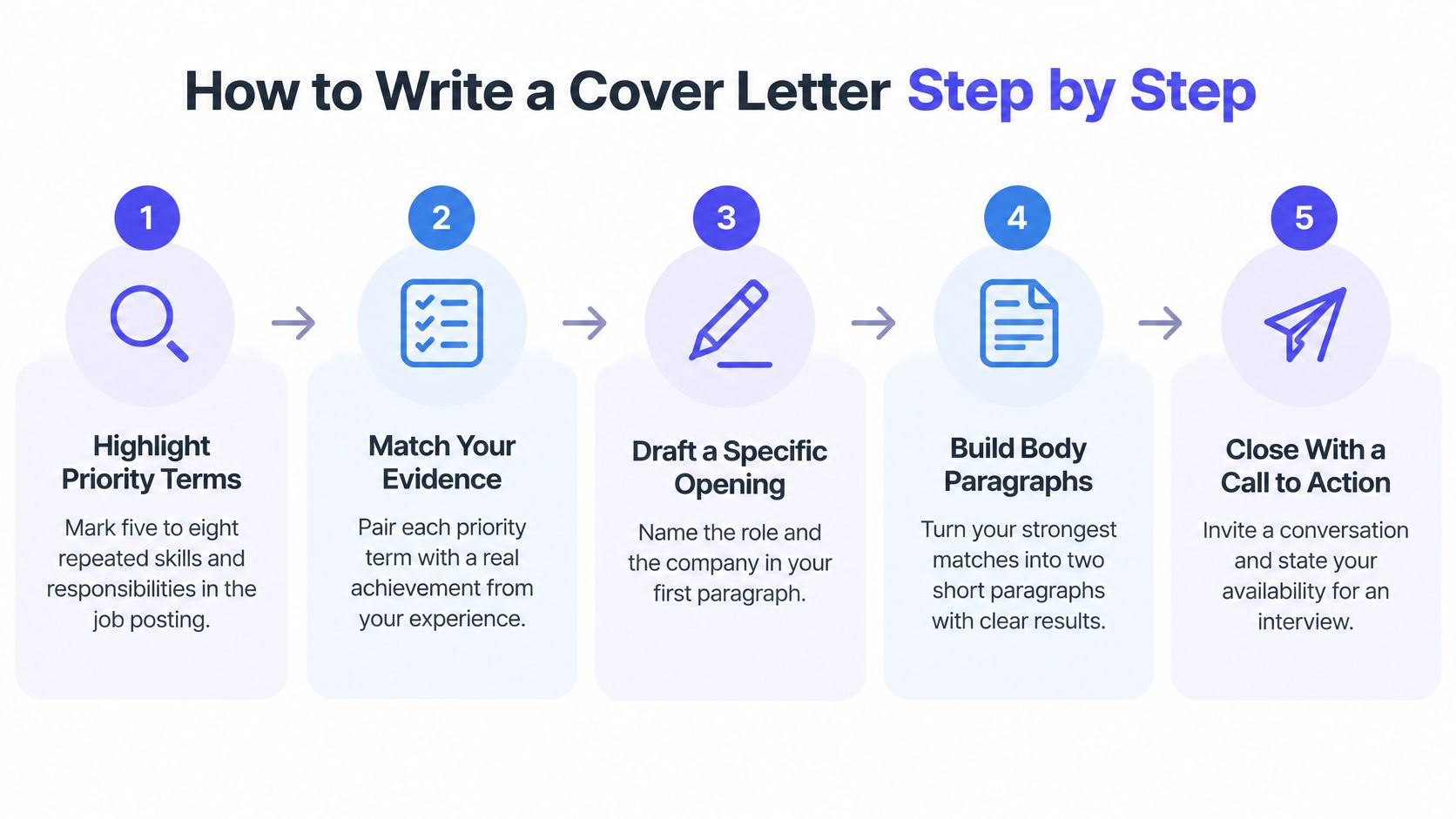
- Mark five to eight priority terms in the posting, especially repeated skills and responsibilities.
- Rank the requirements by importance and by the strength of your evidence.
- Pick two or three to address. More often turns the letter into a task list.
- Write a one-sentence thesis connecting your strongest evidence to the role.
- Draft one evidence paragraph per requirement. Say what you did, what changed, and what your contribution was. Use numbers only when accurate.
- Add the opening and close. Lead with a relevant reason for applying; end with a straightforward invitation to talk.
- Check the fit. Every paragraph should help answer why this role, this employer, or you. Cut the rest.
- Trim to one page and keep the formatting consistent with your résumé. Harvard's Mignone Center recommends factual writing and a one-page limit.
What an evidence paragraph actually looks like
This marketing coordinator example is hypothetical, not a real application:
I rebuilt the weekly social calendar around three product-launch posts. Trial sign-ups from those posts rose from 40 a month to 110 over two quarters. Fewer posts, each tied to a signup goal shared with sales, made the difference.
"Led the social calendar" describes a task. The revised version shows a decision and a result.
How long the first draft takes
Choosing proof takes longer than typing. Once you know which requirements to address, DashApply's Cover Letter Generator can create a draft in one click using your real experience and the job posting, rather than a template with swapped-in placeholders. Review the draft for the right priorities, add any employer detail that matters to you, and verify every name, title, and claim before sending.
Opening Lines That Earn the Second Sentence
"I am writing to apply for the marketing coordinator role" repeats information already in the application. Open instead with an employer detail, a relevant result, or a real connection. Keep it to two or three sentences.
Three openers you can copy the shape of
Employer observation. Connect a specific company priority to work you've done.
Before: "I am excited to apply for the SDR role at Harbor Metrics." After: "Harbor Metrics just opened a mid-market team for its compliance product. In my last SDR role, I booked 28 first meetings in a quarter by leading with buyers' audit deadlines rather than the feature list."
Proof first. Lead with a result tied to the top requirement.
Before: "I am a results-driven sales professional passionate about pipeline." After: "Last year I sourced $1.4 million in qualified pipeline for a six-person SDR pod, with a 22% meeting-to-opportunity rate. Much of that work involved first conversations with buyers unfamiliar with our product, which fits your new-market SDR role."
A real connection. Name a referrer, event, or specific reason the work matters to you.
Before: "I have long admired your mission." After: "Priya Shah on your partnerships team suggested I apply for the SDR opening. She knows my outbound work at her previous company, and your expansion targets accounts similar to the ones I booked there."
The swap test
If you could change the company name and send the same opener elsewhere, make it more specific. University of Maryland career guidance recommends naming a contact and explaining your interest in the organization and role. Use a name only when you can verify it. Otherwise, "Dear Hiring Manager" works.
Tailoring the Letter to the Role and Employer
Tailoring changes both the proof you lead with and the employer detail you choose, not just the company name.
| Role family | Evidence to lead with | Employer detail to research |
|---|---|---|
| Marketing | Campaign results, conversions, or pipeline contribution | Audience, channels, recent campaign or launch |
| Sales and business development | Quota, pipeline, deal size, or win rate | Target market, product, expansion plans |
| Operations | Time or cost saved, volume handled, process changes | Sites, service levels, operational changes |
| Finance | Forecast accuracy, close time, savings, or reporting owned | Reporting structure, growth stage, regulatory context |
| Consulting | Client problem, analysis, and decision influenced | Client sectors, practice focus, published work |
| Career switch | Transferable result in the employer's terms | Why this sector and problem now |
Why the difference shows up in callbacks
A field experiment conducted from July 15, 2019, to January 10, 2020, sent 7,287 fictitious applications to postings on ZipRecruiter, Glassdoor, and Indeed. ResumeVera's summary of the test reports callback rates of 10.7% without a letter, 12.5% with a generic letter, and 16.4% with a letter customized to the position. That's about 53% more callbacks for the customized letter than for no letter, compared with about 17% more for the generic one. The test used fictitious applications and online postings; your results may differ.
Use the posting's exact title and a few central terms, but don't copy its wording wholesale.
What only this employer would recognize
"I admire your forward-thinking culture" could describe anyone. "Your checkout team added a wholesale portal for independent grocers, and I've forecasted stock for a similar portal" points to a specific match. Look for one relevant detail on a product page, About page, or recent company post, then return to your evidence.
If you're switching careers, translate your results rather than apologizing for your title: "I owned a weekly labor forecast for 12 sites and cut overtime 9% without dropping coverage." Make sure the résumé supports the same story. Tailoring the résumé to the job description can help align the evidence in both documents.
Dos and Don'ts Before You Send It
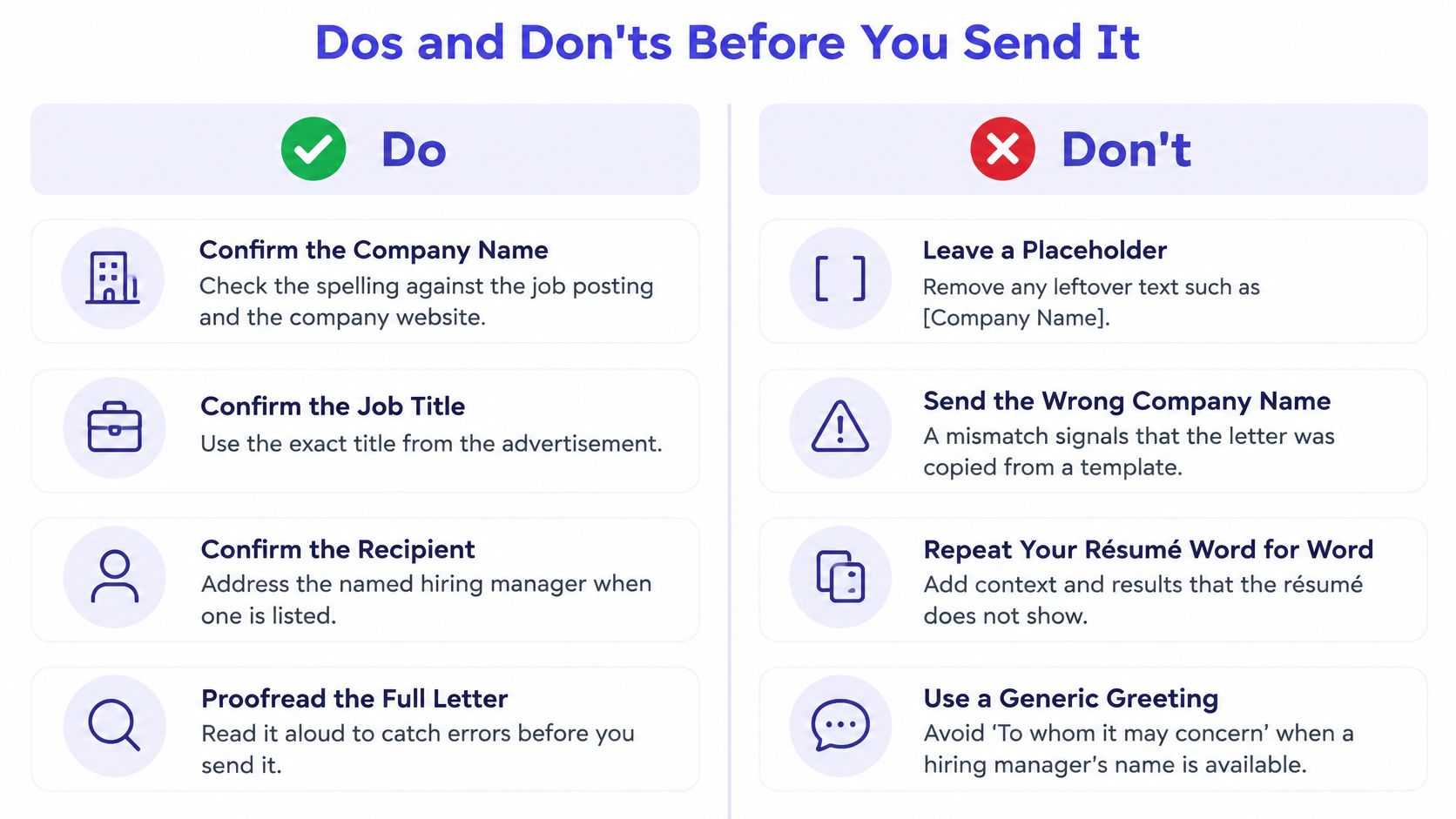
Before attaching the letter, confirm that it adds useful evidence and contains no wrong names or leftover placeholders.
Do this before you attach the file
- Verify the company, title, and recipient against the posting.
- Proofread for meaning, then for details. Ask someone to read it aloud if possible.
- Keep claims you can defend. Describe your contribution, not a team result you didn't own.
- Match the résumé's formatting. Use a readable font and size. For federal roles, follow the announcement's requirements. OPM's formatting notes address federal applications for second-chance applicants, not a universal cover-letter format.
Don't send these
- Don't open with "I am writing to." Lead with relevant proof or a specific reason for applying.
- Don't use unsupported labels such as "go-getter" or "team player."
- Don't reuse a letter unchanged. Search for old company, product, and role names.
- Don't add decorative graphics or fonts that clash with your résumé or display poorly.
- Don't paste unedited AI output. Replace generic wording with decisions and results you can explain.
In a 2025 survey of 600 U.S. hiring managers, TopResume reported that 19.6% would reject an application they believed used a fully AI-generated résumé or cover letter; 25% said cover letters should stay AI-free. Use tools to organize a draft, but write your motivation and career-change explanation in your own words. The same TopResume report notes that some employers notice obvious AI use.
If you couldn't explain a sentence in an interview, revise or remove it.
Editable Cover Letter Templates to Adapt
Use these structures when you want to write from scratch. If you already have a résumé and posting ready, DashApply can generate a cover letter draft in one click from your experience and that specific job. Either way, keep only details you can verify. Replace every bracket in a template with a true detail or delete the line.
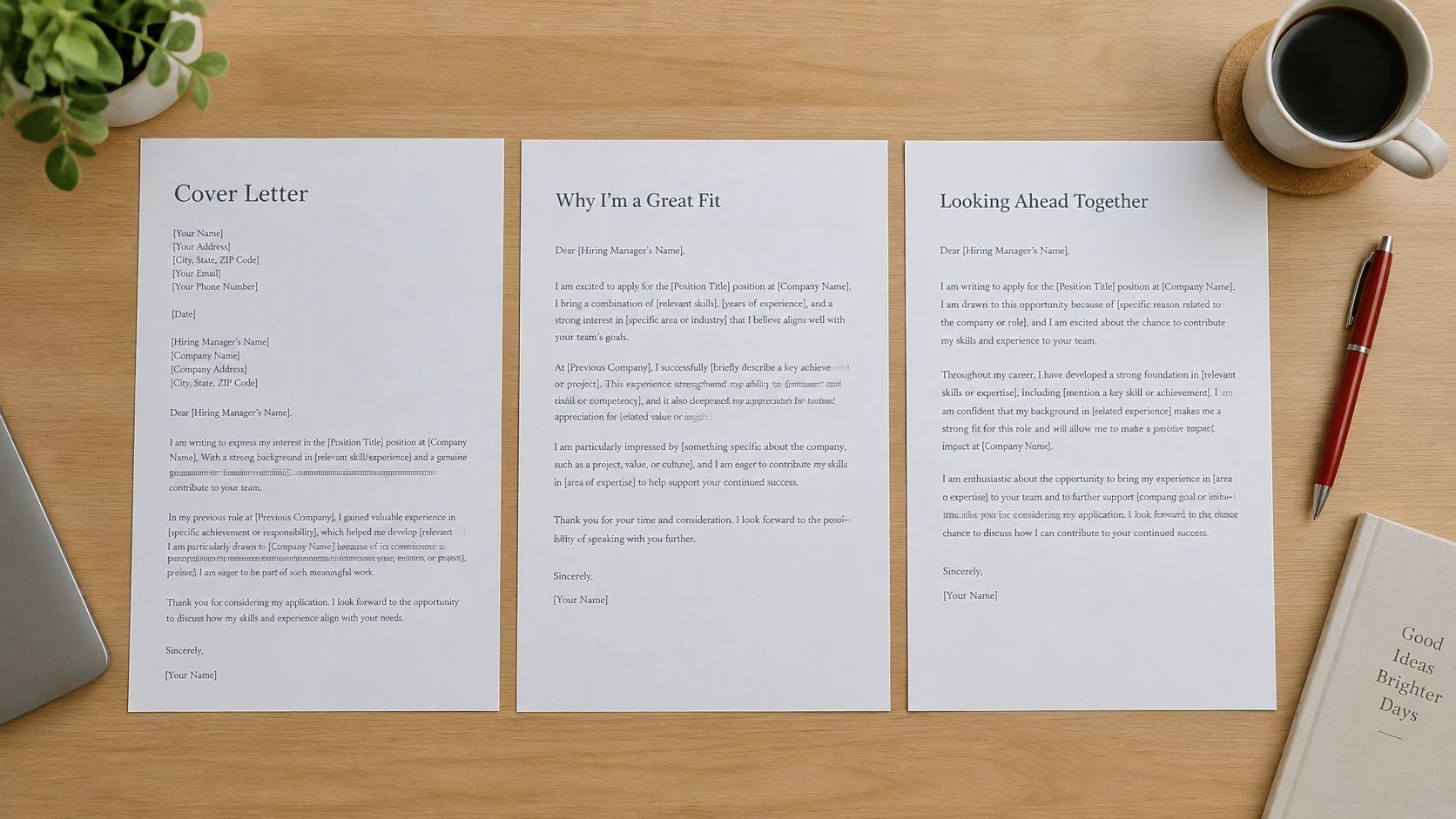
Standard letter for a clear match
Use when your experience directly matches the role.
[Your name]
[Phone] | [Email] | [City]
[Date]
[Hiring manager name]
[Company]
Dear [Name],
I'm applying for the [exact job title] because [specific employer reason]. My experience in [competency one] and [competency two] fits your priorities.
At [employer], I [action]. [Result, if measurable]. That work relates to your need for [posting requirement].
I also [second action], which led to [second result]. I'd welcome a conversation about how that experience could help [team goal].
Sincerely,
[Your name]
[Phone]
[Portfolio or profile link, if relevant]
Career switch letter
Use when your current title doesn't describe the work you want to do next.
Dear [Name],
I'm applying for the [target function] role at [company]. As a [old title], I [transferable action and result relevant to this role].
At [employer], I [specific action]. The outcome was [result]. I want to bring that experience to [company's relevant work or problem] because [specific reason].
I'd welcome a conversation about where I could contribute to [team] in the first six months.
Sincerely,
[Your name]
[Phone]
Referral or relocation letter
Use the lines that apply. Get a referrer's permission before naming them; include relocation details only when useful.
Dear [Name],
[Referrer name] suggested I apply for the [exact job title]. [If relevant: I'll be based in [city] from [month], with [brief logistics detail].]
At [employer], I [action and result matching the posting]. I would welcome a conversation about how that experience could help [team].
Sincerely,
[Your name]
[Phone]
[Portfolio or profile link, if relevant]
The format check
Keep it to one page, match the résumé's font, and use a clear file name such as Lastname-JobTitle-CoverLetter.pdf. Remove every unused bracket.
Draft Your First Tailored Letter This Week
For your next application, check whether a letter is required or would fill a genuine gap in your résumé. If it adds nothing, skip it. If it would help, pick two or three requirements and match each to a result you can explain.
DashApply can show a role's match score before you tailor your résumé. If the application needs a letter, generate a draft in one click from your experience and the job posting. Then check its opening, claims, and tone against your résumé before sending it. You can track the application and follow-ups in the same place. Start with your next role at DashApply.