 The DashApply Team
You're reading a posting on your phone at lunch. The title looks right, but halfway down, the employer seems to want a marketing specialist, a sales analyst, and an occasional magician. You close the tab, or apply anyway and hope someone can explain the job later.
That decision runs both ways. A job description tells employers what to screen for, and employers say accurate postings are what attract the people they want to hire. For you, it works as an evidence map: each line signals what the hiring team will judge, and whether the role deserves your evening. Read it well, and both sides recognize a match before anyone rewrites a resume or sits through the wrong interview.
Table of Contents
- Why Job Descriptions Matter to Both Sides
- What a Job Description Really Is
- How Clear Postings Improve Matching
- How Skills-Based Hiring Changes What a Posting Means
- How Job Descriptions Shape Screening and ATS Filters
- Legal and Pay Signals Hidden in Job Descriptions
- How to Read a Job Description Step by Step
- Read Your Next Posting Before You Apply
Why Job Descriptions Matter to Both Sides
Say you're considering an operations role. You've managed reporting, coordinated vendors, and fixed messy handoffs, but the posting mostly describes an energetic self-starter. You can't tell which experience matters, and the recruiter won't necessarily get the evidence they need from your application.
In a TEKsystems survey of approximately 13,000 job candidates and more than 1,400 employers, employers ranked accurate job descriptions as the most important factor for attracting and hiring top talent; 81% of candidates identified accurate descriptions among the top recruiter actions, behind consistent communication at 85%.
Who reads a job description and what they need from it
| Reader | What they look for | What a vague posting costs |
|---|---|---|
| Hiring manager | Specific outcomes and must-have skills | Weak first-round interviews and wrong-fit hires |
| Recruiter | A fast fit check against the role's intake notes | A long review queue and slower shortlists |
| Applicant tracking system | Matching titles, tools, and skill terms, where matching is enabled | Qualified applicants scored low because the terms don't line up |
| Candidate | Whether the duties and conditions match their experience and goals | Applications sent to roles they wouldn't accept |
| HR and legal staff | Essential functions, qualifications, and the basis for pay | Compliance questions and inconsistent screening decisions |
An applicant tracking system isn't a universal hiring robot. Employers configure their systems differently, and some use them primarily to organize applications rather than score them.
A posting succeeds when suitable people recognize themselves in the work and unsuitable candidates have enough information to opt out.
That's why job descriptions are important beyond attracting attention. They give managers, recruiters, and applicants a shared starting point. Without it, everyone can work diligently toward a different version of the same job.
What a Job Description Really Is
A job description is the employer's working specification for a role, not an advertisement wearing a suit. A menu sells the meal; a recipe says what goes in it. Candidates need more than appetizing adjectives.
An internal job description defines the work. An external posting presents that work to potential applicants, ideally without changing its substance or hiding its less glamorous parts.
Start with the work, not the wording
The U.S. Office of Personnel Management's definition of job analysis describes systematically gathering, documenting, and analyzing a job's content, context, and requirements to connect the work with the knowledge, skills, and abilities needed to perform it.
That connection is the useful part for applicants. A well-built description lets you trace a requirement back to something the employee needs to accomplish.
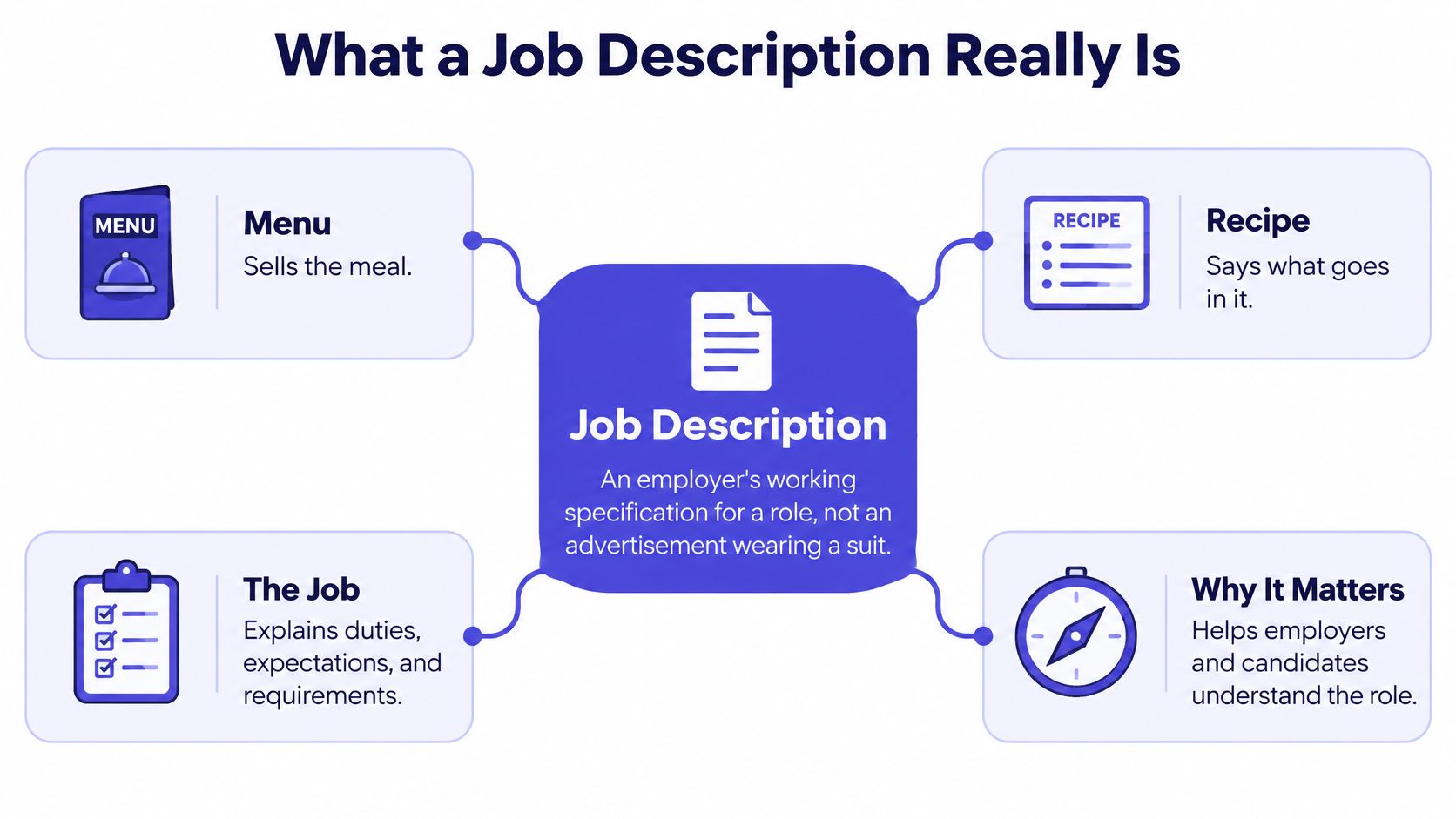
Read the document through these layers:
- Responsibilities show the work. Maintaining a forecast, coordinating launches, or preparing management reports tells you what the role involves.
- Competencies show the capabilities. Analytical judgment matters when someone must explain why a forecast changed, not just update a spreadsheet.
- Qualifications show what evaluators will check. Relevant experience, credentials, and selection criteria indicate how the employer plans to establish readiness.
Working conditions and pay belong alongside those layers. The same responsibilities can represent very different opportunities when travel, schedules, decision-making authority, or compensation change.
Build an evidence map
Say a finance posting emphasizes explaining budget variances to department heads. Group your evidence around that responsibility: the reports you prepared, the discrepancies you investigated, and the decisions your explanation supported.
Don't scatter unrelated phrases throughout your resume just because they appear in the posting. A bullet describing how you reconciled conflicting expense records is more useful than an unsupported claim of analytical excellence.
If the employer asks for a competency that no duty explains, investigate. An unrelated qualification might reflect an outdated template, an unstated responsibility, or a genuine requirement that needs clarification. It isn't automatically proof that you're unqualified.
How Clear Postings Improve Matching
Some postings tell you plenty about the employer's enthusiasm and almost nothing about the job. By the end, you know the team is passionate. You still don't know whether you'll own a process or spend your day chasing approvals.
A useful description provides a realistic job preview. The U.S. Office of Personnel Management's guidance on realistic job previews explains that well-designed previews can reduce turnover and increase new-hire commitment by narrowing the gap between expectations and reality.
That requires honesty about both appealing and difficult aspects of the work. An applicant who dislikes frequent client escalations should discover that responsibility before accepting a customer operations role, not during onboarding.

Weak versus stronger posting
Consider this hypothetical sales operations opening. Both versions could describe the same vacancy, but only one gives applicants something concrete to assess.
| Element | Weak posting | Stronger posting |
|---|---|---|
| Purpose | Fast-paced rockstar to wear many hats | Owns weekly reporting for three regional sales teams |
| Outcomes | None listed | Three to five outcomes with what success looks like |
| Skills | Self-starter with 5+ years | Excel and Salesforce required, preferred skills listed separately |
| Credentials | Degree preferred | Degree stated only where truly required |
| Pay | Competitive pay | Pay range with the basis for placement |
| Reporting and setup | Not stated | Reporting line and working setup named |
The weaker version encourages generic applications. Candidates can claim they're adaptable, motivated, and comfortable in busy environments without demonstrating whether they can do this particular job.
The stronger version invites relevant evidence. Someone who has reconciled CRM exports, corrected inconsistent pipeline stages, and prepared reporting for sales leaders now knows which work to describe.
For employers, the trade-off is straightforward: specificity may discourage some applications. That's useful when the people opting out wouldn't accept the actual conditions. A larger applicant pool isn't necessarily a more suitable one.
Use the Tuesday test
Practical rule: If you can't picture a typical Tuesday after reading the posting, the employer hasn't explained enough of the job.
Look for day-to-day tasks, the reporting line, regular collaborators, tools, busy periods, and clear expectations for the early months. An honest downside helps too: recurring deadline pressure, repetitive reconciliation work, or difficult stakeholder conversations.
A description doesn't need to provide a minute-by-minute schedule. It should distinguish the central work from occasional requests. Preparing a campaign report and owning the entire marketing function aren't interchangeable responsibilities.
The relationship between duties, capabilities, and expected results is also the useful starting point for understanding job mapping. Start with what the person must deliver, then identify the experience that supports it.
Decide whether the uncertainty is worth it
A vague posting may reflect hurried writing rather than a badly managed team. You can pursue the opportunity while keeping unanswered questions visible, especially when the employer or industry interests you.
But you don't owe every unclear vacancy an application. If the posting leaves your nonnegotiables unresolved and offers no sensible contact route, skipping it is reasonable.
If you continue, prepare questions such as:
- Success: What would successful performance look like after the early months?
- Daily tools: Which listed systems would I use regularly, and which can I learn after joining?
- Scope: Which responsibility takes the largest share of the team's time?
Specific answers can justify further effort. Another round of adjectives probably can't.
How Skills-Based Hiring Changes What a Posting Means
A degree or a familiar job title can be convenient shorthand for capability. It can also obscure someone who learned the work through an adjacent role, a career change, or a less conventional route.
The NACE 2025 employer survey found that almost two-thirds of employers used skills-based hiring to identify candidates, and more than two-thirds of those employers used it always or most of the time.
NACE also identified competency-based descriptions, behavior-based interviews, and resume scans for specific skills among employers' methods. For candidates, that makes demonstrable work more useful than collecting credentials that resemble the requirements list.
Separate capability from shorthand
Sort requirements by what they establish:
- Demonstrable skill: Vendor reporting, account research, financial reconciliation, or campaign analysis. Bring evidence of doing the work.
- Mandatory credential: A qualification the employer explicitly requires and confirms isn't substitutable. Don't assume strong adjacent experience overrides it.
- Possible proxy: A degree or experience requirement that may stand in for business knowledge or independent working ability. Ask whether equivalent experience is accepted.
Say a posting requests a bachelor's degree and experience managing vendor reporting. The degree might be a proxy, but don't decide that on the employer's behalf. Vendor reporting is something you can substantiate through a dashboard you maintained, a monthly report you owned, or a process you improved.
Translate a skill into evidence before translating it into resume language.
For example, explain that you consolidated vendor updates into a shared report and flagged missing submissions before review meetings. Add a result only when you can support it; you don't need to manufacture a percentage.
The survey describes an employer trend, not a promise about a particular vacancy. Read the actual wording and confirm uncertain requirements.
How Job Descriptions Shape Screening and ATS Filters
Recruiters use the posting's requirements to decide what deserves a closer look. Some applicant tracking systems also support searches, matching, rankings, or screening questions based on related terms.
How a system weighs those terms varies by employer and vendor. There's no universal keyword formula, passing score, or formatting trick that makes an unsuitable application suitable.
How screening reads each part of a posting
| Posting element | What screening typically does | What to mirror in your resume |
|---|---|---|
| Job title | Compares past titles and close synonyms | Use the posted title in a target-role heading where accurate, without changing historical titles |
| Required skills | Often treats them as must-have match terms | Name the exact tools and methods you've actually used |
| Preferred qualifications | Usually informs ranking more than eligibility | Include them where you have real evidence |
| Responsibilities | Recruiters check relevance of past duties | Describe the related duty in a bullet with a real result |
| Years of experience | Can work as a quick filter in some systems | State your actual experience accurately and let the bullets explain its relevance |
| Location and work setup | Often acts as a hard filter, such as on-site or hybrid | Confirm compatibility before tailoring, and state location or relocation plans accurately |
The distinction between software and employer decisions matters. A rejected application might reflect a screening answer, a recruiter's judgment, or a closed vacancy, not a missing keyword. Understanding ATS integration helps separate application handling from assumptions about automated evaluation.
Match language without inventing experience
Use the employer's terminology when it truthfully describes your work. If you maintained Salesforce records, say Salesforce rather than leaving the tool unnamed. If you only received exported reports, don't describe yourself as a Salesforce administrator.
Keyword stuffing creates a different problem: a reviewer can see the terms but not the capability. A disconnected tools list won't explain how you used those tools, and an invented skill leaves you defending a claim you can't support.
The posting filters applicants before software does
Candidates also screen the employer through its wording. A 2025 salary-range experiment found that women were more likely than men to view narrow salary ranges as signals of fairer pay and were more likely to apply to those roles.
That's a useful reminder for hiring teams: who applies depends partly on how clearly you explain the opportunity. A broad applicant pool begins with credible information, not merely searchable terminology.
Legal and Pay Signals Hidden in Job Descriptions
The duties list can matter beyond recruiting. Under the ADA, a qualified applicant must be able to perform essential functions with or without reasonable accommodation, according to the U.S. Equal Employment Opportunity Commission's employer guidance, which also identifies descriptions prepared before advertising or interviewing as evidence of essential functions.
Distinguish central duties from an overloaded list
The EEOC identifies relevant considerations including whether the position exists primarily to perform a function, whether other employees can share the work, and the expertise or skill it requires. A written description is evidence, not the only consideration.
For an applicant, start with responsibilities that define why the job exists. If a finance role centers on reconciling accounts, that deserves more attention than an unexplained requirement to support unrelated office activities.
You can ask the employer or HR how accommodations are handled during recruitment and employment. You don't need to resolve a potentially important question by guessing from a loosely written task list.
A lengthy requirements list doesn't make every item equally essential.
This is general information, not legal advice. If a requirement or accommodation question affects your rights, seek advice appropriate to your situation and jurisdiction.
Give pay wording a practical check
A posted range helps only if you can understand what it represents. An employer might combine different locations, experience levels, or compensation components in a way that leaves your likely offer unclear.
Ask these questions:
- Is the range credible? Does it appear to describe this role and level, rather than several different jobs?
- Does it reduce uncertainty? Can you reasonably judge whether an acceptable offer is possible?
- Is placement explained? Does the employer identify how experience, location, scope, or other factors affect starting pay?
For sales and business development positions, distinguish base salary from variable compensation. Ask what the advertised figure includes rather than assuming it's guaranteed pay.
A missing range is information you can weigh, but it doesn't tell you the employer's motives. If compensation is a deciding factor, establish alignment before investing in a lengthy assessment or interview process. Likewise, a clear range is useful disclosure, not proof that every pay decision will be fair.
How to Read a Job Description Step by Step
Read for a decision first and resume wording second. Otherwise, it's easy to spend your energy polishing an application for a job you wouldn't want.
A repeatable reading routine
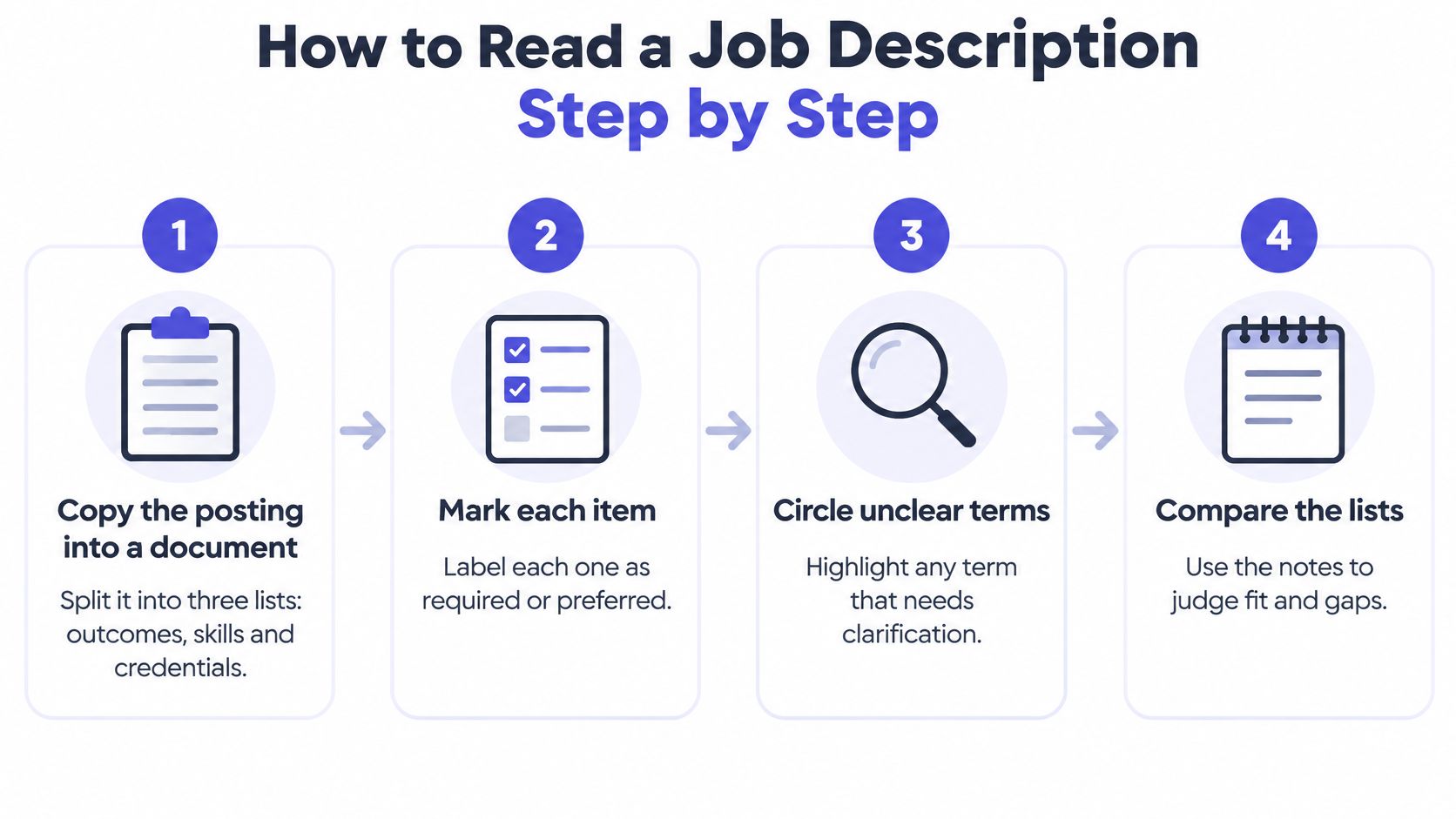
Copy the posting into a document. Split it into outcomes, skills, and credentials. Keep the original wording available so you can distinguish the employer's statements from your interpretation.
Mark required and preferred items. Circle repeated terms and highlight anything unclear. Repetition can suggest emphasis, but copied boilerplate isn't proof of priority.
Compare the role with an occupational profile. The Bureau of Labor Statistics Occupational Outlook Handbook describes typical duties, work environments, education and training, median pay, and job outlook. Use it to investigate unusual requirements, not to assume every employer defines the occupation identically.
Record unresolved conditions. Use the pay questions above, then note missing details about progression, reporting relationships, travel, or working arrangements. Turn each important gap into a question rather than a hopeful assumption.
Place your evidence beneath the outcomes. Write a relevant example and a result you can substantiate. Evidence can come from adjacent responsibilities, not only a matching title.
Choose your route. Apply with a customized resume, seek clarification first, or skip. Don't confuse being capable of some duties with wanting the whole job.
Common snags and useful fixes
- Too many must-haves: Consider applying when you can deliver the main outcomes and meet genuine nonnegotiables. Don't treat preferred extras as automatic disqualifiers.
- An unfamiliar title: Compare duties and scope with your work history. Similar titles can hide different jobs, and different titles can describe similar work.
- Missing pay: Use occupational pay information as context, not an assumed employer range. Confirm the actual budget when it determines whether you'd proceed.
- No numerical result: Describe an observable outcome, such as a completed reconciliation or a documented handoff. Accuracy matters more than decorative arithmetic.
Read Your Next Posting Before You Apply
Before the next posting earns another round of resume editing, give it a deliberate read. A posting works as a filter in both directions: it tells the employer what to screen for, and it tells you whether this role deserves your hours.
That pause protects your effort. You might find a strong role hiding behind an odd title, or spot a dealbreaker in the working conditions before you have spent an evening tailoring. Either outcome counts as a win. Skipping a bad fit costs nothing, while a careless application spends the one thing volume never refunds: attention.
Your aim isn't to look qualified for every posting. It's to make your real qualifications clear for work that fits.
If the role still looks right, DashApply shows you a match score before you spend time tailoring your resume. It can help you decide which jobs deserve a closer read, but you should still check the posting for important details such as pay and working conditions. DashApply's resume tailoring then reads the specific job description and rewrites your summary and bullets to match it, based on what you have done. Review and edit every line before downloading, because AI-generated text can contain inaccuracies and the responsibility for checking it against your history stays with you.
A better-matched application is the goal, not a guaranteed interview. Keep ownership of both decisions: whether the job deserves your application and whether every claim in that application is true.
DashApply offers ATS-friendly resume formatting, job-specific resume tailoring, and an application tracker so you can keep the posting, your evidence, and your follow-ups in one place. DashApply currently offers a free trial period followed by a paid plan suited to your needs. Visit DashApply with one posting you have decided is worth pursuing, and create a draft you will review before using.